Monday, 27 July 2009

Number 100 at Davos, but never easy

Finishing the 2009 K78 Swiss Alpine Marathon was one of the highlights of my few years of running. But it was also one of the hardest races I've had. The whole time I had pressure on myself to beat last year's time by as much as possible with the certainty that I would finish no matter what. I had to - this was marathon number 100, I had about 30 friends racing or spectating at one of the events of the weekend, plus I even had a great big medal from the 100 Marathon Club engraved with the date and race name.

So I was never likely to take it easy and was looking forward to really seeing how much I'd improved on mountains. It wasn't as much as I'd hoped and I was still hopeless at running for long periods uphill, spending much time walking. Luckily I've never had a problem with downhill running and made up time on every drop. That's always one of the most fun things about running for me - kamikaze-style leaping from rock to rock on steep, off-road sections, ideally with mountains as a back-drop.

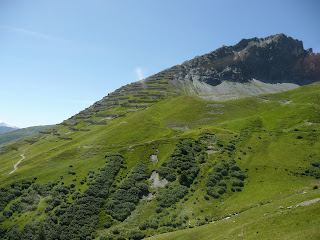
I'd been looking forward to the race for ages since the 78.5km (49 miles) course is beautiful and I've run in Davos the previous two years, doing the marathon K42 and the ultra K78 in that order. The whole event has several other shorter and easier races too, but all are significantly more difficult than running on roads and much more rewarding (see the photos with this write-up for why).

The early morning flight didn't bother me much, neither did the 2h30m journey from the airport to Davos Dorf station. Between the plane and train I'd picked up three other Serpies (Angus, Jess and Ben) and we met up after checking into hotels to collect our race numbers in the slightly underwhelming expo. We'd persuaded Jess to switch from being a spectator to running the 11km race and I also bumped into my first friend from the 100 Marathon Club, Dave Ross, and his new fiancée...in fact she only upgraded from girlfriend to fiancée the previous day in the romantic setting of the Alps. So a pretty positive start to the weekend.
Most of my friends were staying in a hostel about a mile from the centre of town, so the evening downpour persuaded them to stay indoors while I met people staying more centrally in the main bar on the Promenade. Was great to get into the spirit of the event and I always love the anticipation before a big event. I'd managed to help to persuade quite a few people to race it, mainly the ultra, so much of the chat focused on that and how the heavy rain and recent snow would affect the course. We were also celebrating the recent victory of two mates in the Gobi March the previous month, Dave and Diana. They'd run together the whole way and Diana had won.
Before I got too carried away with the Swiss Weissbier, we all called it a night in preparation for the 8am start. It was still raining heavily but the forecast showed some improvement, not that mountain forecasts can be trusted much.
After a good night's sleep I was nervously excited, as I should be before any decent race. I met up with a sea of Serpie running vests at the start, not just ultra entrants, but Serpies doing all distances who were either supporting or taking part in one of the other 8am start races. The sun was vaguely shining through and everyone was in a great mood. There was a slight panic when one girl (who shall remain nameless) realised she'd left her race number back in the hostel a mile away and there was just 20 mins 'til the start. But she made it back on time and we were all lined up in the huge crowd of starters.
I planned to run as much as possible with Mark Braley, who had raced the K78 with me the previous year. He has a habit of zooming off at the start (his 10k PB is within a marathon) then slowing down, so we planned to pace each other and to therefore have some company throughout the earlier stages of the race at a minimum. However, the pacing mainly involved me trying to rein him in as we set off at 6 min miles, not a pace we expected to be sustainable in the slightest.
We did stay together for most of the first 18km or so, although I spend much of it trying to keep my pace down and only seeing him in the distance. The first section of the race goes to Filisur and is undulating but not as mountainous as later on, plus it has a net drop of 500m (1,700ft). During a particularly fast section of downhill roads (rather than trails) I caught him up and noted that my Garmin was showing our pace around what we do for 5k. Again, not very sustainable, but it was fun and we were able to keep going without being out of breath at all.
I got too caught up in the speed and let my race plan go out the window temporarily. I just wanted to enjoy the ease of running down a good section and saving a few mins from my overall time. Of course, it doesn't really work like that and going a minute too fast early in an ultra can lead to losing many minutes later on. But while it was easy, I didn't think I'd be losing too much later on.
This is where I got too cocky and really didn't need to be overtaking so many people. The race doesn't start until the last quarter so gaining positions early on is completely meaningless...particularly if the people I overtook were in the K31 race which stops at Filisur. I kept up the pace as the course flattened and we had a railway track crossing at 19.5km. The crossing involved weaving in between a narrower section and almost turning back on myself. For this sharp turn I foolishly using a piece of wet wood in the rack to take the weight of me twisting. The slimy surface had no grip and my leg flew from under me like slipping on a banana skin sideways. I crashed into the fist-sized rocks around the rails at full speed and right in front of a crowd of people.
It happened so suddenly after I'd been cruising so comfortably but my first thought was that I still had 59km left to run so was anything seriously damaged? I could stand up, my head hadn't hit any rocks and the adrenalin masked most things. But I could feel a lot of bruises along my right side and chest as well as nasty cuts and blood flowing freely from my right palm.
The spectators wanted to make sure I was ok and were trying to help me up and direct me towards the medics at the water station just ahead. But I decided the best tactic was to see whether I could still run. I could, although this started as a slow limp. Quickly I realised that limping 59km would lead to some serious muscle imbalances as my body had to make up for the poor posture, so I needed to try to run as normally as possible and just ignore the soreness. After a few minutes this wasn't too difficult but was very annoying.
In total I was probably only down for 20-30 seconds but I was running more conservatively and slower from that point. The race had become more serious in several ways - getting a decent time had just become tougher and finishing could even be an issue. There was no way I'd drop out unless I was incapable of continuing, but the wet conditions made a second fall much more likely.
With my slower pace, Mark came into view behind me after I'd broken away previously. I expected to see him join me at my side but at the next water station a few kms later he stopped to drink while I kept going thanks to having a Camelbak to keep me hydrated. My leg and side was loosing up a bit as well and running with a normal gait wasn't an effort, it just ached a bit. Maybe it'd all work out fine after all?
Filisur came soon after, marking the lowest point in the course at just over 1,000m (3,300ft). Ahead was a non-stop 1,600m climb to the top of the first pass, merely a half marathon away (now that would be a tough half marathon!). It started with a section of reasonably steep windy road up to Bergun, where the K42 marathon starts and then continues basically along the ultra route to the finish.Runners kept leap-frogging each other as some alternated between running and walking or just varied their speed. The women's winner came past me at this point and was slicing through the field making the hill look very easy. I blame the flatness of London on my sloth uphill, but when you see the quality mountain runners you have to stand back and appreciate their fitness and technique. They've worked hard to be able to run uphill so fast and it's impressive.
Just before Bergun the road temporarily flattened to give me a breather. I knew there would be plenty of Serpies waiting there as the K42 starts 3.5 hours after the ultra and I was going through town just over half an hour before their start - enough time that they hadn't moved towards the start line yet. Running through the cheering crowds made me put more effort in and to try to look stronger than I felt (especially for the photos). The Serpie support was great and gave me a big boost. There was literally a tunnel of Serpies to run through and I couldn't help speeding up, even though it was a relatively steep road. Of course, as soon as I passed the crowd I slowed my run back to race pace, but it's difficult to not play up to the crowd.
Feeling newly elated and with the earlier fall virtually out of my mind, I focused on the remaining 1,300m of vertical ascent to the highest point. I used my Garmin mainly to tell me my altitude rather than distance and found it helpful to know how much of the climb was done and how much was ahead.
As I remembered from previous years, the roads and tracks were mainly runnable for the next 10km or so and I managed to avoid walking too much until I hit the last 700m of ascent where the path gets noticeably steeper. Everyone I could see was walking, except one long-haired and orange-tanned man just ahead. He was jogging but going at the same speed as the walkers which just looked like a huge waste of energy.
This is the part of the course most people love (and hate) the most. The scenery gets more mountainous and the number of trees drops to none eventually. Snow patches also started appearing and the temperature was clearly colder than lower in the valley. I was glad of my two layers as it only got colder as I climbed. It can be hard to fully appreciate the view while the calves scream at you and your heartbeat races, but I was well aware that being there was something special and that I'd made a very good choice for my 100th marathon.
I kept thinking how tired my legs were and also got some minor cramps in my calves which I had to stretch out, which normally isn't an issue for me. I managed to overtake more people than overtook me but I was disappointed that my recent hilly races hadn't helped me deal with the climbs more. Challenges like the Ultra Trail du Mont Blanc or the mountainous US 100 milers now looked even more daunting, but also more tempting.
Eventually I saw the top of the pass ahead and above. I was 10 mins quicker than the previous year so had still managed to force a little more from my legs even after my crash. I was exhausted and my legs were painful from fatigue. When I started running down the rocky path on the other side, I felt a new lease of life and the tiredness ebbed away. The change of which muscles were being used made all the difference and I was back into race mode, overtaking people again.
This high section of the course between the two mountain passes lasts 7km and drops 200m before climbing back to over 2,600m again at Scalettapass. It was cold, exposed and difficult terrain to get a footing in due to the rocky, muddy and waterlogged path. But it's one of the best parts of the race and after Scalettapass it's just over 18km left and that involves almost no uphills and a drop of almost 1,100m.
Concentration has to be at 100% along these sections at the top otherwise a misplaced foot happens too easily. After the race plenty of people had cuts, bruises and limps to show that the slippery conditions had taken a few other victims.
I managed to only get overtaken once, by the female winner from the previous year and 2005, a local runner. She was powering along the uphill towards the second pass, but not as quickly as the leader of the K42 marathon who zoomed past, having caught up about 40 minutes on me over the 24kms of his race. He flew up as if he hadn't just done a huge climb already. But after that pass it was steep downhill and I knew that hardest part was over.
I stuffed my face with food at the water station at the top then set off down the steep paths. I could see far ahead and there were a few runners strung out over the path as well as plenty of hikers and supporters. It's amazing just how many people make the effort to hike far into the mountains to support their friends, family and everyone else who runs by. Cow bells and shouts of 'Hopp! Hopp! Hopp!' let you know it's definitely Switzerland.
The next few kms were all sharp declines, zig-zagging down the barren slope. I loved it and kept leaping around as if I hadn't been running all day. The second major shift of the race from steep climbs to steep descents again helped ease up the seemingly non-stop hammering on the calves. But it only shifted it to the thighs which soon started feeling it after a few hundred metres of going down the other side.
Soon I was tired again, but the rocky paths soon transformed into grassy, tree-lined paths with a gentler slope. I just kept focusing on the next runner ahead to try to catch each one, but the last 10k went by without seeing anyone behind or ahead. There were only a couple of tiny hills left, but they were still a bit demoralising. Then the last few km were started off by the 75km marker and the path entering the woods before popping out just above Davos for a tarmac road down to the stadium.
Just as I approached the entrance to the stadium and was exhausted from a prolonged sprint finish, I saw two more Serpies, Lou and Gav, with a big camera. I was spurred on for an extra last bit of effort and to not look too drained in the shots. Then there was just half a lap of the track to go past the big crowds. I couldn't help playing up to the crowd once again (I never can), slapping hands and reacting to the louder cheers with every extra bit of speed I could muster.
It had been tough, one of the hardest days of running I've had. But the fact that it had been hard, as well as beautiful, meant that I could appreciate the effort it had taken to get through it. I was limping immediately after stopping but was happy to have got through in one piece and to have lowered my time from the previous year by 12 mins to 6h51m and 15th man.
I spent the next few hours watching other Serpies and friends come in (that's Dave and Diana finishing below). Almost everyone had had a great race and really enjoyed it. Many had been converted to trail running, mountains or ultras. The beers through the afternoon were well deserved all round.
Apart from cleaning ourselves up and going out to the pub to celebrate, I just had one more thing left that day. Since the Chairman of the 100 Marathon Club was also running the K78, we'd arranged for a small presentation of my medal for joining the club at the finish line at 9pm.
At that time there were about 25 Serpies gathered round as the sun disappeared over the mountains. We cheekily used the winner's podium for the presentation and I was honoured to have so many old and new friends around to make the occasion more special. After a tiny speech several bottles of champagne appeared from nowhere, including one to spray podium-style. I was taken aback and felt like I was lucky to have good friends to share the day and the moment with. Some great photo opps occurred too, including me pouring the champagne from the stage into James 'Mr ultra-long ultra' Adams' mouth. Trying to get hold of that shot now.
The rest of the night went quickly but I was so tired and sore I couldn't stay too late. Davos had been a fantastic race, just as I expected. And it reminded me that distance running is never easy and can always push you further than expected. I hope that my future trail races in the US live up to it, but I'm sure there'll be plenty of top experiences still to come. And after so many people had such a great time, I know a lot more Serpies will be enjoying the fun and challenges of mountain running.

Sunday, 19 July 2009

Musings on 100 marathons


Ever since I started running, back in 2005, I've had a focus on marathons and ultras. When I first entered the Marathon des Sables I expected it to be a hobby and just something to keep me fit. I even remember saying once that I thought I'd probably do around 10 marathons in my life and had no desire to do 100 and join the ranks of the 100 Marathon Club.

But after maybe six months of running I found that there's something extremely addictive about getting up at stupid o'clock on a weekend and running a very long way. Even more addictive to race against other people and test myself. And the most addictive element is the improvement and satisfaction from seeing progress month by month. It's also taken over much of my social life and I mainly spend free time (in Europe, at least) with runners, especially from my club, Serpentine.

So something which was intended to keep me fit and give me some new challenges has become so much more to me. I now can't imagine my life without running, although if something happened to stop me, I know I'd find the nearest equivalent, whether that's cycling/wheelchair marathons etc.

It didn't take long to work out that I would end up doing a lot of marathons and that I would, inevitably, join the 100 Club. It became even more obvious when I switched my focus to ultras early on, so marathons are necessary training runs.

This July I've had more cause than usual to consider my goals since I've had two significant events. Firstly, I completed my 99th marathon or ultra at the Tanners 30 miler at the start of the month. At the finish I felt a sense of relief that I'd be on target for my 100th at the Davos K78 ultra in the Swiss Alps at the end of the month. No dangers from DNFs screwing up my calendar or injuries making it impossible to fit in enough races.

My second event of the month to get my mind whirling was the knee injury I picked up after a 'football marathon', a 12-hour tournament for charity just two weeks before Davos. In hindsight it wasn't worth the risk, but I hardly ever play contact sports and wanted one last chance to playing football before moving to the US soon where a game of 'soccer' would be much harder to arrange. But I'd done it in two previous years and managed to avoid injury. This time a bad tackle caused a niggle and a kick near the end of the tournament started me limping.

The knee problem didn't phase me too much since I'm generally an optimistic type and all the running's made my body recover much quicker than it used to. I've had several races where I've finished and been certain I've injured something, rather than just pain from fatigue, but then been very pleasantly surprised to find that it cleared up within days and barely interrupted training.

This time I knew I had two weeks to heal and was pretty certain that the muscle behind the knee was damaged, rather than the ligaments or complicated mechanics within the knee. Muscles tend to heal quickly for me so it seemed like things should be fine. But the Davos race is a mountain race over unforgiving terrain. I managed to jog every day after the injury, but only very slowly and only on concrete or a treadmill.

It's now a week later and I managed to get back to racing yesterday, with a 10k followed by a 1k immediately afterwards. Not my best performances but the knee was solid and barely hurts even if I bend it oddly to test it. It needs to be perfect within another six days and I have a 1 mile and 3k race before then to confirm how it feels.

I'm confident it'll be ok, so that takes me back to my original thoughts about what completing 100 marathons means to me. Quite simply it means a lot and it means very little. The importance is because it's a good landmark to remind me of all the great experiences I've had over the past four years and the amazing places and people I've met. I didn't expect to see as much of the world as I have due to running, but I've immensely enjoyed the deserts, mountains, varied cities and trails. What better way to sight-see than to get entire cities covered in a day and with roads closed? Or spectacular (I'm finding I'm using that word a lot, especially to describe Davos to people) mountain views which can only be reached through long hikes or running trails? There are many places I wouldn't have gone to if there hadn't been a race as an excuse - I've even seen much more of the UK than in my pre-running days, covering many scenic corners and hidden gems.

The reason the mark of 100 marathons also means very little is that it is a means to and end, not an end in itself. I'm not hanging up my trainers after Davos, so it's just the start of a long running career. At 28 I'd hope I've got another 50 years of running in me (good genes from longevity in my grand-parents helps) so I know there's so much more to look forward to. My list of races I must do gets longer, rather than shorter, as I keep finding more events which catch my imagination.

Running inspires me and I hope I can take it to as high a level as possible, both in terms of pushing myself further and being able to enter/complete some of the hardest races out there. I'm genuinely excited by the thought of so many events out there and even impatient to do them all, even though there's no rush and they'll eat up a lot of cash over the years.

So here's my main must do list of races I know I HAVE to do, in no particular order. There are plenty of others and if I was restricted to just these I would struggle to get by and would get bored in my training. Happy to have any further suggestions for similar races as there's always a chance I haven't heard of something, even with all the Googling and picking of other ultra runners' brains.

Boston marathon, USA (every year - must do)
Comrades marathon, South Africa - 55 miles (ditto, but less local from the States)
Two Oceans marathon, South Africa - 35 miles (2010)
Western States 100, USA - 100 miles (every year I can get in)
Ultra Trail du Mont Blanc - 103 miles (2010 probably)
Marathon des Sables - multi-stage, 153 miles (maybe if I can justify the cost again)
PCT 50, USA - 50 miles (2010 then whenever I can)
Atacama Crossing, Chile - multi-stage, 150 miles (eventually)
Gobi Challenge, China - multi-stage, 150 miles (eventually)
Badwater, USA - 135 miles (2011)
Leadville 100, USA - 100 miles (eventually)
Hardrock 100, USA - 100 miles (eventually)
Great Wall of China marathon, China (eventually)
Inca Trail marathon, Peru (eventually)
Hood to Coast relay, USA (soon)
Lake Tahoe triple marathon, USA - 3x marathon (every year)
Goretex Trans Rockies, USA - multi-stage, 100 miles (eventually)
Other mountain marathons/ultras in the US
Plenty of other road marathons

Saturday, 4 July 2009

Taster for the Ultra Trail du Mont Blanc – Mont Blanc Marathon, 2009


After the disappointment of the 100k not going to plan the week before, I had one more June race to fit in. I’d not given the Mont Blanc Marathon much thought since it was just another race on my route to 100 marathons (number 98, in fact), but in the days coming up to it, I started to get excited.

I’ve not done many mountain races but have loved every one of them and this promised to be a great course with fantastic views of the tallest mountain in Europe. As I found out a few days before from the profile, it had more climbing than I’ve ever done before, with 2,500m (over 8,000ft) of ascents. And these mainly come in two patches – a 1,000m section from 18km (11 miles) and another towards the finish. So when I got to Gatwick for the early Saturday flight and met up with another Serpie runner, Rob, I knew I was in for a treat as well as a tough challenge.

A few hours later we’d flown into Geneva in Switzerland and got our bus connection to Chamonix in France. It was a scenic drive and less than 90 minutes so it was only midday when we checked into the hotel. Mont Blanc towered over us with rugged glaciers dripping off it like an ice-cream cone. The valley was reasonably warm but overcast so we hoped that the predicted thunderstorms would hold off.

The rest of the day was lazy with a visit to the expo and the buffet with unlimited alcohol. Rob took advantage of this to a greater extent than I did, but we both got a good feed and needed to walk it off.

That evening I had a light jog along the river while Rob had a nap due to our early start (and probably the beer). But it was an early night to get ready for the 7am kick-off on the Sunday, which was 6am, UK time.

The morning weather was much brighter and we walked to the start to hear over the loudspeaker that the forecast was for a great day. That’s good for scenery and photos but the heat is an issue with all the sweaty, exhausting uphill hikes. However, it’s preferable to thunderstorms which would create rivers in the tracks and make it even harder to force the body higher and dangerous on the way down. That might be relatively easier for the runners with a multitude of walking poles, but not for us.


Once we got going, Rob and I jogged slowly together, intending to take it easy and save lots of energy for the mountains. However, I knew that the first 18km were basically runnable, although there were bound to be some small sections of walking due to the gradient. So I had a plan in my head to not go too easy up to that point or I’d get stuck in a huge queue of people walking slowly up the 1,000m climb. I also didn’t intend to race the marathon and to just use it as a training session for the Davos ultra marathon a month later. That meant I was trying to not get too tired, although it doesn’t matter how slowly you go in mountains as it’ll always take a toll.

I lost Rob after about 10 minutes and jogged in the shade of the mountain, enjoying the views from bottom of the valley. It was surprisingly cold in the shade and I could see everyone’s breath turning to steam. I wanted to get as far as possible in the more comfortable weather and aimed to miss the heat of the full sun on the big climb, if possible.

Then I bumped into Dan Afshar, another British ultrarunner, and chatted to him for a bit. He was training for Davos as well as his main event, the Ultra Trail du Mont Blanc (UTMB). This 166km (103 miles) race in August circumnavigates round Mont Blanc, going through France, Switzerland and Italy in a non-stop route under a 48-hour cut-off. At 9,600m of ascent it was almost exactly equal to four times the Mont Blanc marathon. That’s a mind-blowing challenge given that I was to find out that day that the 2,500m of climbing would make for the hardest marathon course I’ve ever attempted.

Even this early on, I had seen enough of the area to know that I’d want to race there again. And I don’t like to shy away from a challenge so the UTMB had started to etch its way on to my ‘must do’ list. But the main focus on the day was to get through the mere marathon distance in one piece and love every second of it. I was on track, but wasn’t sure how I’d fare on the unrelenting hills after not doing much hill training, except for the undulating Comrades marathon (1,400m of ascent and 1,900m of descent over 89km).

By the second water station at almost 18km I was cruising and psyching myself up for the huge effort ahead. I had my Camelbak full of energy drink but intended to take on a lot of fluids during the race as well as eating from the later water stations to add to my gels.

Then the big uphill came along, with a turn off the dirt road on to a single track. I saw the competitors ahead of me in a never-ending line of walkers. Some we resting hands on thighs to ease the climb and some used their poles to ease the burden on their calves. It’s certainly an interesting feature of mountain races that sections like this are very slow and that overtaking almost happens in slow motion. The stronger uphill athletes clearly moved through the field and since I was only around 100th of the 1,500 starters, I was also able to overtake the whole way up.


Most of the path was through forest until it got higher and we came through the trees. I looked at my Garmin watch constantly to see what altitude I had reached, knowing that the bottom was 1,200m and the top was just over 2,220m. I promised myself a rest after 500m vertically, but at that point there was a brief respite and I had a half km of flatter then slightly downhill running. So that counted as a rest and I aimed to have no stops whatsoever.


As the path opened out I had views of the mountains which were now showcased beautifully from the higher vantage point. There was another water station at 22km and it was just 200m vertically from the highest point. My legs were feeling fine and so was I so the helicopter which kept circling and filming overhead got plenty of waves from me. The last section of the climb was much rockier and also got steeper. I was clambering over the rocks rather than power-walking. But the pure blue sky was a perfect backdrop for the snow-capped peaks which surrounded me. It had been annoying to be behind runners using poles (or not using them and just letting the points jut backwards with every step). Those runners didn’t seem to care that they might accidentally spike other people with their over-extended arm movements and I had to dodge jabs a couple of times from oblivious Frenchmen.


At the top, I took in the achievement of getting there, but used the flattened terrain to speed up. But there’s one thing better than the scenery. What might that be? The chance to run downhill along rocky paths like a maniac, of course. Of all the types of running, downhill over difficult terrain has to be my favourite. You can let yourself go and just fly down, but you have to concentrate completely because you need to see the ground far ahead to plan your route. There’s the adrenaline rush from the speed and the risk, but that risk is completely in your control...unless your legs are so tired that they buckle or don’t respond quickly enough. I wasn’t close to that issue, but it made me think (after I’d got to the bottom, since I had no time to think about anything else while careering down the path) what it would be like to try the course at night or near the end of the UTMB. I don’t know how difficult to would be but I’d love to find out. Of course, in a race that long there’s no benefit to pushing the speed on the way up or down as the game is to conserve energy and strength, but it still intrigues me what it would be like.

I was into the business end of the race with the last 15km, roughly. My body felt ok, but I could tell that the fast run down the mountain would hurt the next day (as it did) due to absorbing so much impact in the quads. I’d been overtaking people non-stop since I’d left Rob near the start, but the field was more spaced out in the latter stages. It gave me something to focus on as I pushed through the undulating section of course.

The sun beat down to make it extremely hot and every extra positive gradient made me sweat even more. I knew that I had a significant climb up to the finish as I’d reached the low point of 1,400m and the finish was at 2,000m. Also, I’d already gone through my slowest marathon time and was still a fair way from the finish. One thing this proves is that this race is the hardest marathon I’ve run, although I’m fitter than I used to be so I didn’t find it an ordeal and was able to enjoy every second.

After a significant steep section in scorching sun I reached the last checkpoint where some Brits cheered me on since they recognised that Serpentine is a London club. I was relieved to have more water and other drinks and downed a few before grabbing some food and eating it without even chewing.

I still had some more climbing to do but I soon heard the PA system from the finish line, which echoed round the valley. I kept up a forced power-walk and my calves were sore, but very bearable. I noticed how the very steepest sections had a very immediate effect on the calves but that the majority of uphills felt tough but ok. There was a short downhill which lost about 50m of elevation but instead of this being a welcome release, I was annoyed that it meant I had to climb another 50m back up before the finish. I often start to resent easy downhills when I know there’s a target height I’m going towards since they just undo some of the effort I’ve put in to get to where I was.

Like everyone else, I couldn’t wait to get to the finish line and then I saw it ahead, but maybe 100m above me. I’d never had such a hard end to a race, but at least I was within spitting distance of relaxing and just enjoying the view. One final push and I even forced a sprint finish, although it would have been the slowest one in any race I’ve completed. The finish line and area behind it had hundreds of spectators cheering everyone on. In fact the whole course had had much larger crowds watching than I’d expected. But once I crossed the line I headed straight for the shaded refreshments – heaven.

The view from the finish area was the best I’ve ever seen in a race and I was glad that I’d have a chance to take it all in while waiting for friends to finish. What an excellent race and what a perfect location. Hard as nails but so very rewarding. They even had beer at the finish.

I managed 25th in 4h43m and even the winner didn’t break four hours. Rob came in just under six hours and commented it was the hardest thing he’d ever done, but after a few beers he seemed to be recovered. All that was left was to take a few photos, take the cable car 900 vertical metres down to Chamonix and enjoy the free buffet with even more free booze.

Apart from relaxing back at the hotel, we just had the trip back to Geneva and London to fit in on a jam-packed day. But it wasn’t rushed and it was very easy, and even relaxing, to fit in so much just over a Saturday and Sunday. I’d recommend it to anyone, although it helps just a tad if you’ve done some running and hill walking. I had a 5k race the next day and knew I’d need a lot of rest after such a tough race so that’s what my mind switched to on the plane home...as well as the UTMB.

Monday, 29 June 2009

Running with the internationals at the 100km World Championships, Flanders 2009

I’ve never successfully run 100km (62.2 miles) in a day before so was looking forward to the chance to race against some of the best athletes from many countries around the world. However, I have tried to run 100k twice before. The first time was near Cairo and was two weeks after I’d been racing in the Himalayas and had spent the time back home with some kind of chest infection from the cold and altitude. It didn’t go well to say the least – I didn’t realise that my thighs had been destroyed by all the downhills since I hadn’t run since returning. So I started out slowly, felt pain in my thighs from just a few miles in then limped through to the 50k marker in agony and had to drop out. Cleverly I’d then entered the 2008 World Championship 100k in Italy the following week but wasn’t even able to make the start line.

The 2009 100k World Championships was also the European and Belgian Championships and was hosted by a prestigious and regular race in Torhout, Belgium – the ‘Night of Flanders’. I like the idea of starting in the evening then running through the night, plus the event was larger than most 100ks due to a marathon and 10k at the same time.

The only problem is that I’m now trying to combine the large number of races I do with getting much quicker. I’m just about able to get away with lots of marathons and shorter races, but if I’m giving everything in the ultras it takes a bit more out of my body. And I’d only allowed 26 days between racing the 55.5 miles of Comrades and the Night of Flanders. That was maybe just enough except I’d also trained hard in between and so not fully recovered.

So when I left for Belgium on the Eurostar with another ultra runner friend, Cleo, I had my doubts about how my legs felt. I was also slightly under whelmed by the prospect of the race, but was hoping than the atmosphere would pep me up when I got to the expo. She was taking the race more as a training run than a race after recently completing the Namibia Challenge, a multi-day desert race in southern Africa.

On arrival at Torhout we had to ask directions in the small town to find the sports’ hall and couldn’t see any of the hustle and bustle I’d expect from such a small place on such a big day for the town. I couldn’t even see any runners, just locals drinking frothy beer in the sun. It seemed very appealing, especially since my legs didn’t feel up to racing an ultra.

In the end we found the sports’ hall just half a mile away and went inside to find a low key organisation with little in the way of sponsors (I can’t even remember if there were any). One of the reasons it had seemed less important in my mind prior to the race is that the website had little detail about the race. No maps of the start and finish areas or other helpful info. In fact, it didn’t even mention the name of the town the race is held in and I had to find that out through Google. They also didn’t state how much the race cost to enter and pre-entry seemed to involve merely sending them an email to say you want to race.

So I wasn’t 100% certain they had my entry, but when I got to the front of the queue they had a race pack for me and asked for the payment of €26, which isn’t bad value compared to standard marathons.

Cleo and myself had a couple of hours to kill until the 8pm start and used the time to change, warm up and chat to a few people, including a contingent from the 100 Marathon Club, of which I’m a member, even though I was three shy of 100 prior to the race. I saw plenty of skinny people wearing tracksuits with their country’s name on, but there wasn’t any other indication that the race was a Championship. No banners or anything similar. If you didn’t already know, you wouldn’t have guessed.

Then with 30 minutes to go we were outside and in the awkward period waiting for the time to pass to the starting gun. The international athletes were everywhere and I was able to recognise a few, including the American champ, Michael Wardian, and the Swedish winner of the past two Davos K78 races, Jonas Budd. There was no male British team at the Championships because they had decided to skip it, but there were two females. Some countries had much bigger teams, including the US (whose women claimed most of the top positions that day).

The sun was still relatively high at 8pm when we got going and there were decent sized crowds along the start area. It was warm and a bit crowded due to the marathon runners starting at the same time and doing the same course. Except they only had the first two laps of the five-lap 100k.

I went off slowly with the aim of 7h20m in my head which I knew was possible if my legs were fresh. That’s the ‘A’ stream qualification time for getting into the British squad but I would have accepted sub 7h35m for the ‘B’ stream time. Going slower than that seemed like a waste and I wasn’t there for a training run.

As I started passing runners, most were in the marathon and were distinguishable by a four-digit race number compared to three for the ultra. I was also going past a lot of the female 100k runners since none of them would be heading for 7h20m and most would be closer to 8h or 9h. I chatted to athletes from countries with English as a first language, including Americans, Aussies, Brits and Irish. But one of the first people I ran with was Aussie team wannabe and fellow Serpie, Andy Dubois.

Andy was aiming to break 8h and make his national team for the Commonwealth Games 100k in September. He had a good shot at it with several 100-milers under his belt and an iron reserve with his training. But I lost him after the first water station at around 10km since I picked up a cup on the run and spilled most of it over my face while he stopped to get a proper drink. The water stations were a negative point about the race since it’s just not possible to drink as easily from a cup as a small bottle when running. So you either break your rhythm and walk through water stations or accept that a sip is all you can get. Over 100k in warm weather, a sip of drink every 5k or so is not enough. Luckily I had my Camelbak too, but it was annoying.

I ran through each 5k distance marker and noted that I’d started slowly, about a minute off pace for the first 10k. I sped up slightly to make sure I’d gain the time back by half way and generally felt comfortable. Lap one passed without and issues, then I was on to the identical laps for the rest of the race. Only lap one had been different, to add in the extra distance for the marathon to finish lap two at 42.2km instead of 40km.

It was still very light as I went through the 25k marker and I’d started to catch some of the male internationals. Things seemed to be going well, but there’s not much that can be taken from that early stage in the race. If you’re not feeling fine at half way then you definitely will slow down a lot. And the key to good ultra running is even splits with little or no time lost due to slowing down at the end. The race doesn’t even start until the last third or quarter of the distance.

So it wasn’t a good sign that I could feel a little fatigue in my legs at 30k. They just didn’t feel right and I sensed that I may run a much slower second half, maybe dropping 30-60 minutes on the first half. That would be miserable, ruin my time and leave me very sore for a few weeks and unable to train properly. I wouldn’t have minded using every drop of energy to get a good time, but if I was going to be over 7h35m it didn’t seem worth the effort.

However, endurance running is made op of good and bad patches in races so I wanted to see whether I was just going through a harder section and that the fatigue would go away. But by about 38k I felt about the same. I hadn’t slowed and didn’t feel bad, but just could tell that my body wasn’t quite fresh enough to run a good second 50k.

The sun had gone down and it was now almost fully dark with flood lights now on around parts of the flat course. I was 4km away from the end of lap two and had to decide whether it was worth continuing. At first I thought I’d give it another lap up to 61.5k and see how I felt but there didn’t seem much point in getting a DNF (Did Not Finish) at that distance compared to 42k. I was certain that my legs weren’t quite feeling as they should.

So what’s the logical thing to do when you decide to drop out a race? Well, I was being sensible and quitting before I really hit any problems so I didn’t actually feel bad yet. Plus I hadn’t dropped off pace and was exactly hitting the 4m24s per km average which I needed. But since I knew it had just become a training run, I decided to push it hard to the marathon finish to get added training benefit.

Immediately I accelerated to about 3m30s km pace and started flying past other ultra runners. I’m sure I must have confused many of them since a sprint finish for the last 60k is ambitious to say the least. I couldn’t quite keep up that pace but still sailed into Torhout going past everyone for a good cheer from the (now fairly drunk) crowds. I even passed the lead lady, Kami Semick (USA), and wished her good luck. She didn’t really need it and won comfortably as I know she tends to do in most races.

When I got to the finishing funnel the officials tried to wave me back on to lap three but I managed to get across to them that I was stopping. Those French exams at school had some benefit, even in the Flemish-speaking Flanders region. However, the marshals wouldn’t let me cross the line until they’d ripped off my race bib which had the timing chip on the back.

I wasn’t particularly exhausted due to going at my 100k pace for less than half the distance and I still had 90% of the drink left in my Camelbak as well as all six gels which I’d carried the whole way and not used yet. I was disappointed but knew that I’d made the right choice. I hadn’t wanted to do anything other than race for a time, but the tiredness in my legs meant that wasn’t a possibility over a full 100k.

On the walk back to the sport’s hall I saw the runners go by, including many I’d chatted to along the way. I was tempted to wait for Cleo or Andy to run by to cheer them but wasn’t sure how long the wait would be and I was hungry. The finish line had only supplied me with an iced tea drink and no food, so I wanted to get back to the hall to get some more. When I arrived there I was disappointed to find no food or drink whatsoever, but I’d brought some of my own in my bag so was still able to replenish some energy. Then the night was finished off with a shower and a sleeping bag in the hall corner where others would join me later on.

Overall it was a decent race and very flat and fast even if the website didn’t help non-locals much. However, I’d not taken the distance seriously enough and hadn’t tapered properly so was pushing it to put in the performance I know I should have run. I also found it annoying that they only had plastic cups at the water stations. The internationals didn’t have to worry since their coaching teams had bottles of their own drinks to give out to them. Maybe next time I’ll have a little assistance, but not yet. It was fun but the World Championships were a low key affair and not nearly as prestigious as in shorter distances, with a much lower quality of field. If I’d run the time I should have been capable of I’d have been around 25th and there are plenty more 100k runners better than me than a mere 25.

Friday, 29 May 2009

Comrades marathon, May 2009

Why no race compares to the Comrades Marathon

Now I admit that I have a bit of a ‘thing’ for one particular race, the Comrades marathon in South Africa. But I’m not the only one given that the average number of finishes is six, for men, and four, for women. So people clearly can’t stay away from it.

I only heard of the race back in 2006 when running an ultra marathon in the UK and chatting to a South African mid-race. When combining those two factors, his nationality and ultra running, one topic of conversation was always bound to pop up – Comrades. Despite its friendly-sounding (or communist-sounding, depending on your inclination) name, this ‘marathon’ is really an ultra marathon on roads, at distances varying around 89km (55 miles) each year.

That distance alone would normally be enough to put most sensible runners off and you might expect about 100 runners to attempt it if in any country other than South Africa. But the draw of the race is so strong that it attracts over 10,000 runners. That makes it one of the big international races and not many have more runners. So why does such a huge field get involved in such an extreme event?

Well, there are many reasons, but the simplest one is that it is the best race in the world, bar none. I’ll back this up with a(n admittedly small) sample of people I spoke to and know who ran it for the first time in May, 2009. They were all massively impressed by the quality of the organisation, the crowd support and the unmatched buzz surrounding the race. There is only one word which truly captures the scale and emotion of the race and I don’t use this word lightly. That word is epic.

What makes a race epic? It’s more than just scale due to the number of runners and the distance – plenty of races have that. It’s the excited conversation in the street with a stranger when they see you carrying the bag from the expo. It’s the chunky hills along the route which make most undulating road races look flat as a supermodel’s chest. But most of all it’s the camaraderie and support from fellow runners, the crowd and (it seems) everyone else in South Africa.

This solidarity really comes into its own as soon as you land in Durban, the home of the race. The city clearly looks forward to the race with eager anticipation and there’s sure to be plenty of runners on the internal flight into Durban. Then the expo has a sense of excitement mixed with trepidation and is so enjoyable that I went back to it three days in a row.

With a build-up over many months due to the training required, there’s almost a sense of relief when the race is just days away. No more hard hill sessions, no injuries and so much to look forward to on race day. So when I woke up on the morning of the race, was I bursting with adrenaline? Well, no, or at least not immediately. But that was only because it was 3am, the start of the race was an hour’s drive away and I’d just reached the point of full realisation that I had to stop talking about running 55 miles of hills and actually do it.

Although I’ve run many ultras and marathons, it still takes a lot of effort to not roll over and go back to sleep. Forcing myself out of bed at unusually early times of day with the prospect of a hard day’s work ahead is tough. But once up it is difficult to not get swept away in a sea of adrenaline. However, I usually try to save a little adrenaline for the race.

The 2009 race

2009 was my third year in a row at Comrades. It has become my most essential race of the year and a good run makes for a good year. PBs at other distances and other races are a bonus, but the whole point is to get better at Comrades. I’d felt this way since my first finish and even more so after meeting some of the elite runners after the race in 2008. In fact, I’d made a big promise to myself – to one day get a gold medal for finishing in the top ten.

Top ten finishes in ultras are generally not that prestigious. Some long races have barely more competitors than that number and rarely are there elite-standard athletes. In contrast, Comrades boasts the best line up of ultra runners of any race in the world. It includes Olympic marathon runners and many others who can break 2h20m and have the talent to translate this into fast ultras, which many can’t. So it means that finishing amongst those top athletes is extremely hard and requires under 2h45m marathon pace for over double the standard marathon distance and with some major hills.

Luckily I didn’t have to reach those levels this year to be happy with my race. Instead I’d set the ambitious target of breaking 6h20m since that was the equivalent of keeping up 3h marathon pace the whole way, which is a nice, round figure. I’d raced a bit too much in the build up to the event but was in decent shape and determined to run myself into the ground if necessary.

So as I lined up in my seeding pen at the start, I was focused and knew I’d prepared well enough to enjoy it fully. The guys around me were restless and dancing to the music booming out over the PA system through huge speakers just metres away. There were a lot of smiles and all runners had their race numbers on both back and front, as required. The numbers include details of their previous finishes and their seeding pen. There were many colours of race numbers, each meaning something different, such as for the number of times they had finished or to show they were an international runner. This is always a conversation starter during the race.

As we hit 5:15am the pen entrances were closed and anyone not there 15 minutes before the start had to go to the very back. That’s more of an issue than usual given that only gun times count and all the strict cut-offs during the race are based off the gun time. That includes the cut-offs for each medal category at the finish, of which there are five based on finishing times plus the hallowed gold which I coveted, but not that day.

The music switched to the traditional starting tunes. Firstly a heart-wrenching rendition of a local mining song called ‘Shoshalosa’ which many locals joined in with the singing. Then the classic ‘Chariots of Fire.’ Never do the classic piano and synth chords of Vangelis sound better than when crowded into the start of Comrades in the dark. Because of the Comrades memories this stirs, the song stops me dead in my tracks whenever I hear it.

And every Comrades runner knows that as soon as the song is over, the agonising months of waiting for the start are over. The next sounds heard are the traditional cock crow of a past runner who started the race for many years until his death. Then silence and the gun lead to the shuffle over the line for over 11,000 people who are willing to try their luck at a distance most would never attempt by foot. Fools! But what glorious fools.

It takes almost an hour to get light and the field is well spread out by that point. I’d reached the first steep downhill, called Polly Shortts at 8km, except the marker said ‘81km to go’, as it counts down rather than up. It’s very pleasant to run down that early in the race but when the course is run in the opposite direction, as it is every other year, this is the hill that finishes most people off near the end. I’d just managed to climb it the previous year using a walk/run strategy but 2009 was a down run and that meant that the hills included nasty chunks of downhill running. This becomes particularly thigh-destroying later in the race and the constant pummelling leaves most people crippled for several days.

It was at this point that I was starting to get into the race and enjoy the company of other runners which defines the race experience. I chatted to a local guy on his umpteenth race. And we caught up with a bus, as a group of runners sticking together is called, for two elite women. Although I was tempted to stay with them and benefit from their pacing and experience, I decided to push on since I was already going a little slowly for the time I was aiming for. I’d stuck to my plan of going at a pace which felt very comfortable and allowed me to talk freely but had been forced to reassess my target time downwards.

As the sun rose there were plenty of small buses I joined, but I spent the most time with two runners in particular – an American, John, and a Swiss guy, Roman. Roman was getting even more support from the large early morning crowds due to his leopard spot hairstyle and the Swiss flag on his chest. He told me at the end of the race that his friends who saw him along the course with Swiss flags had been hassled by a lot of runners. They’d confused the white cross on a red background for the Red Cross flag and had assumed there was medical aid being given out. Many had then stormed off in a bad mood when the unreasonable Swiss fans had had to refuse them first aid.

But he wasn’t the only one getting great support since I’d entered for a local club who had plenty of supporters by the side lines. Kearsney Striders had 61 other runners in the race, including several of my friends, but the male running kit for the club (which is compulsory to wear in the race) looks dated to an embarrassing degree. As my British friends later described it, it looks like a negligee instead of a running top. At least it didn’t look out of place since many other clubs had similar fashion issues, but I did have fun with it posing for some catalogue-style photos before the race.

Anyway, I was very happy to wear it during the race since I got non-stop shouts of support. Many also read my name off my race number to support me that way too. One of the magical parts of the race for me was when I reached Kearsney College at 38km to go. That point is 51km into the race and I’d had a relatively easy time up until then. I’d chatted with many runners and overtaken a lot of the ones who’d zoomed through the first sections of the course. Most of the uphills were over but I knew that there was a long downhill section to come on Fields Hill – the biggest of the main five hills.

So I knew I had a lot left to do and my legs were feeling tired and sore. The camber on many of the sections of road had damaged my left Achilles tendon slightly and that had led to pain in the bottom of my left thigh. Much as I usually love downhill and know I’m much stronger at it than uphills, I wasn’t looking forward to the remaining long run down to the coast. In fact, I started to prefer the climbs since they hurt less.

Then I had a moment in the race which will stay with me as a real highlight of 2009. I was given a balloon half a km away from Kearsney College so they would see me coming and cheer earlier. I approached them certain that I’d have to slow down later and wasn’t certain whether my left leg would hold out for running almost another marathon. But then something clicked in me and I embraced the support to get a massive adrenaline boost. As I danced through the tunnel of Kearsney students, encouraging them to make as much noise as they could, I started to believe that the race wouldn’t just go well but that I could speed up too. After the whacking high fives I was a new runner with fresh legs and I sprinted off down the course, flying past runners.

I hadn’t expected such a big pick-me-up and was thoroughly glad to have worn the retro Kearsney kit. And somehow that boost lasted me through for almost three hours until the finish. It helped that there were even more Kearsney supporters from that point in the course, but I suddenly felt capable of maintaining a faster pace. I didn’t even get on another running bus for the rest of the race, but focused on pushing through for the best I could eke out of my resurgent legs.

The last 38km didn’t go quickly but the huge crowd support and the feeling of moving through the field at pace kept me motivated. I’m used to running the last quarter of an ultra on my own due to small field sizes but Comrades always has plenty of people within sight. I received and gave out supporting gestures and calls to those I ran by. It took all my concentration to keep the rhythm going but the almost clichéd quote from Lance Armstrong went through my head that ‘pain is temporary, quitting lasts forever.’ I’m sure I wasn’t the only one who used that thought to push on to the end. Besides, the faster you go, the sooner the pain ends. I also thought often about my fiancée and was finding the race very emotional in my jaded state.

Entering Durban was as memorable as the last down run I’d completed, back in 2007. However, this time I wasn’t cruising and had to fight for every step. I hungrily searched for each km marker, willing them closer. With just 1km left I knew I’d make it ok and pushed on to save every last second. The crowds were a hazy background to my delirious world but a welcome one.

When I finally entered the Kingsmead Cricket Stadium for the final victory lap it was a very satisfying finish. My legs were so wobbly that I’m not sure I could have gone much further and it seemed that every last drop of energy had been squeezed out during the previous six hours and 29 minutes. I tried to sprint finish but couldn’t increase my pace much. Then I crossed the line of the ‘Ultimate Human Race,’ as Comrades rightfully describes itself.

At the end I was too exhausted to take in the whole experience but I knew that the coming hours and days would be filled with real satisfaction. My legs were shot, but they’d held out. The crowd had spurred me on to push my body harder than ever before. Plus I’d met inspiring people before, along the way and also in the finishing area.

That evening, I was even lucky enough to have dinner with friends and two of the race’s greatest performers – three-time winner, Helen Lucre, and nine-time winner, Bruce Fordyce. Bruce is a living legend in South Africa and it’s impressive for a slight man to gain such prominence in a rugby-obsessed country. I’d read his book and have the utmost respect for his commitment and achievements. However, since he stills runs Comrades and had finished the day with a bronze medal, just under ten hours, there was plenty of banter about my shiny silver medal. His great quip was that silver does tend to tarnish, leaving unsaid that his 11 gold medals obviously do not.

There’s a unique feeling to Comrades which causes people to come back year after year and still be as excited as a five year old on Christmas Eve. It’s not just one thing, but the combination of everything to do with the race. And when a city truly embraces an event it creates an electrifying buzz. It also helps that Durban is a great city on the sea and that I have good friends living there.

Running the race makes you feel invincible and capable of anything. It inspires people to push themselves to new heights. Although there will be many credible athletes going for those top ten spots in races to come, I’m determined to give myself the best shot possible of joining them. I’ll be returning to the beautiful rolling hills near Durban every year possible because there is no alternative. This race is in my blood.

Land of the Yeti Duathlon, Nepalese Himalayas, October 2008


Land of the Yeti Duathlon, Nepalese Himalayas


50km running (2 stages), 100km mountain biking (3 stages) – 20/10/08-3/11/08

To anyone who knows me, I’m very firmly in the runner category and I’ve never really used a bike for anything other than transport. Basically I’m not a bike racer of any sort. Yet when I was looking for an excuse (read ‘race’) to go to the Himalayas, I picked a duathlon – the Land of the Yeti Duathlon in its first year. Seemed like a good idea at the time.

In preparation I bought myself a mountain bike and had excellent intentions to train with it and learn the art of mountain biking on some of the world’s harshest terrain. Unfortunately all I managed to do was the Edinburgh Rat Race with a day of basic and mainly flat mountain biking.

So when I flew out to Kathmandu I knew I was in store for a tough race. It started relatively easily with a flight out to Lukla at 2,850m and nine days of acclimatising by gradually trekking the well-worn route to Gorak Shep and Everest base camp and staying at guest houses along the way. The full list of competitors totalled seven with three locals and four westerners, one of whom was the race director. The locals couldn’t afford to spend money and time taking so long to get to the race start, so our party consisted of just the westerners and three guides, including the illustrious Snow Monkey (mentioned in Lonely Planet, no less) to sort out accommodation and generally take care of things.

Each day we trekked for a few hours and it became noticeably harder to ascend as the air got thinner, just as the mountains gave increasingly stunning views. Never has the word ‘majestic’ been more appropriate than when describing the snowy peaks of the Himalayas against a clear blue sky. I’ve raced in the Swiss Alps at up to 2,600m and found that there was no effect on my breathing, but once we started trekking above 3,000m the thin air came into play. We were covering the course for the running stages of the duathlon so were keen to not see too many downhills, which would be uphills in reverse. As we climbed higher the scenery became ever more breathtaking so it was lucky that we could take our photos at leisure and not worry that we would miss anything when running back that way.

After what seemed like much more than nine days we were ready to go from Gorak Shep at 5,140m. We’d been to Everest base camp, seen many mountains of over 8,000m (including Everest) and climbed Kala Patthar at 5,565m. I’ve never had such an interesting build up to a race, but we all wanted to get going, if only so we could sleep properly again and be able to walk without wheezing. This wouldn’t be the fastest race I’d ever been in, for certain. We had certain compulsory items in our backpacks for safety and additional warm clothing which we had to carry ourselves, but the Nepali racers had ignored most of this compulsory aspect to the race and had much lighter backpacks. This was an omen of the race organisation and attitude to follow.

The first stage was 30km long from Gorak Shep to Namche Bazar which has a net 1,700m drop in altitude, but still with around 700m of climbs. Only those genetically disposed to altitude, like the locals, or who have had months or years in the mountains can move quickly at these heights. This made the three Nepalis firm favourites to beat the westerners and we weren’t disappointed. One of them, Dipak Raj Rai, won the previous three Everest marathons and holds the course record.

Unfortunately one competitor succumbed to acute mountain sickness just before the start and had to go down lower to the mountain rescue doctors. He was fine to join us from stage two. But the rest of us were up and ready to get going with a great 50m climb to start us off. The race director started us at 9am and took video of us jogging uphill and past him. I made a point to look good for the camera and went past in first place, but a mere 20m into the race (and past the camera) I had to start walking uphill due to the sudden heart attack which was almost brought on by my jog. This definitely would be a tough one…

The Nepalis had shot off into the distance and I’ve never seen such a marked contrast as between the locals and the westerners since they were covering the initial ground around three times faster. It was the hardest fell race I’ve ever been in, with uneven rocky steps or tough, dirt paths the whole way. The hardest factor was the extreme altitude for the entire stage which made my heart pound non-stop. Until I dropped 1,000m my maximum speed was around 5mph, but my heart and lungs were working at an unsustainable rate and it felt more like 5k pace.

The familiar villages of Lobuche then Pheriche went by gradually and I managed to overtake one of the Nepalis after 30 minutes. The other two had such a big lead I had no chance of getting near them, but it was enough effort to concentrate on not tripping over the rough ground. It was impossible to even jog on any uphills but I kept up as much pace as possible on the flat or downhill sections.

I passed through Teng Boche with its Buddhist monastery and the 200m climb before then 400m climb afterwards strained my heart. It was good to be only a few km from the end and with not much more than an undulating and easier trail to Namche. I managed 3rd but was over an hour behind the winner, Dipak, with my time of 4h14m. The others came in over the following few hours and we spent the rest of the day getting our breath back, literally.

Day two looked like the easiest of the five with only 20km to cover and relatively little undulation – 600m of uphills and a net fall of 600m to Lukla where we’d flown into. I fancied this as my best stage since the air was thicker, but it was still thin enough to be felt. The stage started with a sharp drop of 600m out of Namche, which I remembered as a tough climb from the other direction. The fastest two Nepalis shot off at unbelievable speed down the large rock steps but must have got lost somewhere since I found myself in the lead until almost the bottom. I heard the patter of footsteps behind me and it was lightning Dipak chasing me down the zigzagging path. He caught me just before the rope bridge and looked a lot fresher than me since I was huffing and puffing like a fat man sprinting.

On the other side of the bridge I had to revert to my previous tactic of walking every uphill because they were just so steep. The top two Nepalis disappeared into the distance again, but I kept up as good a pace as possible. There were more trekkers along this lower part of the Everest trail and they usually clapped or cheered in their native tongue. But some seemed quite put out and even refused to make any room to get past.

I managed to get back into second before the end of the stage and ended it 20 minutes behind with a time of 2h11m. The last man in took over five hours, but he had several excuses – a one-hour nap en route, a dodgy knee, a general insanity and a hangover which led to the nap (cunning tactics from his Nepali compatriots the evening before, perhaps?).

After such a short stage we had some time to play around with the bikes which we had left in Lukla in preparation. I generally copied the seasoned bikers, checking the brakes, suspension etc, but I was getting quite worried that my inadequate training could lead to problems. Even though I’ve not really mountain biked before, I planned to use the same kind of intuition as required for fell running to pick the best route and I’m generally competent mucking around on a bike. However, you won’t really find a harder training ground than high altitude trekking paths for a baptism of fire into the art of mountain biking.

So after a decent night’s rest, we were up and ready for the three biking stages. The other westerners were hoping this would be their chance to shine after finishing way back in the running stages. The three stages were from Lukla to Nunthala (described as 30km, 40% ridable and 7-10 hours expected time), Nunthala to Kinja (described as 26km, 50% ridable and 9-12 hours expected time) then Kinja to Jiri Bazar (described as 47km, 80% ridable and 6-9 hours expected time). These each included significant amounts of ascent, with Nunthala to Kinja being so difficult due to over 2,000m of climbs and even more of downhills. Yet things were not as we expected…

We started off on the first downhill out of Lukla as a group and managed to ride for a couple of minutes before the boulders and other obstacles made it impossible to ride. We had to push or carry the bikes over the obstacles and were well spread out after the 600m descent and up the similar ascent on the other side. It was completely impossible to ride and it dawned on me that since we were on the trekking route, which is rarely a good track and not sloping, there may be a very small amount of biking. At this point I still trusted the course description so wasn’t too fazed, but after carrying or dragging the 10kg bike over 700m vertically of terrain on which it couldn’t even be pushed, I wasn’t having fun. The Nepalis had overtaken me on with their bikes resting naturally on their heads or shoulders as they trekked upwards quickly. But then the race director overtook as I had no will to try to race a stage of carrying a bike. I commented that I thought a duathlon was meant to involve riding a bike and he said this should be the case.

Sadly we found out at the end of that stage, after 1,300m of vertical ascent and under 1km of actual riding, that the race director hadn’t checked out the course personally. Although the scenery over the three biking days was undoubtedly great, it was difficult to appreciate when having to carry the bike the whole way. Rather than the sparser terrain at higher levels, we went through areas which were more jungle-like and equally beautiful. I finished day three in 8h43m and in 4th, behind all of the locals, but hadn’t wanted to push it too much since it no longer felt like a race. The two other westerners who’d paid for their entry were similarly disappointed with the lack of a course and actually arrived in the dark. We decided that since the forth day was meant to be the hardest and it looked very likely that it would be similar terrain to day three, we’d give up on the idea of the event being a race. Instead we allowed the three guides to carry our bikes then started with everyone else at 5:30am to get the maximum hours of light. We toyed with the idea of making it a three-way running race but there was no appetite from any of us – day three had been physically and also mentally tiring due to the disappointment.

It was lucky we left the bikes to be carried for us since the 26km turned out to be a massive underestimate. The GPS device with the race director showed 55km, but it seemed to skip about 15km at one point so we don’t quite believe it was this far, but certainly a lot more than expected. I had a gentle stroll and still took over nine hours, but the other two without bikes came in last, well after dark had fallen. The two high passes were particularly tough but we only missed out on a couple of km of ridable sections. This added justification to not continuing in the official race, as did the fact that the legendary Dipak won it again but had a puncture and had carried the bike every step of the way.

The last day supposedly was an easier one with the majority being ridable. However, after the surprises of the previous two days I stayed with the other paying westerners so we could finish together. The initial, ‘easy’, climb turned out to be around 1,000 vertical metres of steps, so we took much longer than anticipated. We also found that there were multiple routes and we had no map, just the name of the finishing town, Jiri. So after five hot hours at lower altitudes we got a chance to do some mountain biking. This was spoiled by the fact we had little idea which way we were meant to go and we were exhausted from our efforts. Yet we did over two hours of tough downhill riding where I was very happy to manage not to fall off at all.

As darkness approached we found ourselves asking every local which way to Jiri and getting answers in Nepali which even we could tell meant that it was a long way away. Helpfully, different people pointed different directions and the same old man even pointed both directions down a road depending on which one of us asked him. We were demoralised, knackered and all a bit ill from the cold temperatures at altitude and the strains on the body. So we decided to stay in the next village overnight and try to contact the race director.

Luckily two of the guides popped up just as we stopped at a shop (they have a habit of appearing and disappearing very suddenly). We were very glad to see them but less glad to learn that it was over a two-hour cycle to Jiri and there was only an hour of light left. Given that all timings we’d been given for distances were more appropriate for the leaders than the scope of the entire field, we also took the timing with a pinch of salt and decided that leaving early the next morning would be the best option. 7am seemed reasonable, but at 5:45am we had a knock on the door from the guides to say it was time to go. We were not amused, especially after sleeping on the hardest beds of the entire trip with no mattresses.

Day six of the five-day race was also a chore. I opted to go on the walking route over the mountains with one guide while the other guide could bike with the other two. My legs were fine since it had mainly been my lungs and heart which had been tested by the stages. So I knew that the claimed two-hour trek would actually take that long – I’d be fine keeping up with the Nepali march of a Sherpa for such a short time. I had my doubts about how long the bikers would take, but by having guides with everyone, we’d guarantee that nobody could get lost.

I arrived into Jiri after exactly two hours and ate a big breakfast while waiting on the others. Again, the distance to Jiri had been underestimated by the race director, but everyone seemed to have taken a different route so who knows which was shortest? Even when the bikers arrived there was a wait for a ceremony, which seemed slightly farcical given the fact that the race had been very different to how it had been sold to us. We were all in one piece and the first aid kit had remained almost unused, which was lucky since nobody was medically trained (the official thinking seemed to be that you either deal with it yourself or use your insurance to get air-lifted out!). So by 11am we were ready to go along the first mountain road we’d seen for the entire trip. The bikes were loaded and the westerners too, then we had a mere eight-hour drive to Kathmandu to cover the scenic 195kms.

We’d all had an amazing time and seen some spectacular sights. The Himalayas are certainly an incredible venue for a race and I don’t regret doing the event. Yet it was so badly organised that it was downright dangerous. Some of the hardest fell running in the world but no medical support. Small amounts of very tough mountain biking along cliff edges but mainly exhausting bike carrying and with no contingency plans – once the first bike stage was started, there was no way back except a helicopter and we had no option but to continue no matter how ill, tired or injured we were. We were lucky there were no medical emergencies but the toughness of the competitor’s fitness and will-power was a larger factor in getting us back to Kathmandu.

The Land of the Yeti Duathlon is dead. The race director admitted that it had been executed very badly and that there wasn’t really a mountain biking circuit there. The approximate 150km course would make for a very hardcore running stage race, and that was effectively what we did (less the competitive element for most days). But if anyone reading this likes the idea of running near Everest, there are already several excellent one-day and multi-stage events to choose from, such as the Himalayan 100-Mile Stage Race in India at slightly lower altitudes or the Tenzing Hillary Everest Marathon from base camp to Namche Bazar (very similar to day one of LotY and this is what Dipak has won the last three years). There are also multiple biking races and tours, but I’d recommend picking one which has been held previously to ensure they know what they’re doing and that there is an actual course.

One word of warning about this sort of race. I found that even two weeks after my return my legs were more damaged than I’d expected, when I’m usually fine within a couple of days of an ultra. I tried an 100km race and had to drop out purely because my thighs were knackered. The massive, high altitude descents from the Himalayas had left me more crippled than any other race. I hadn’t expected this, especially since I had two weeks off running and the 100k was completely flat. Yet there seems to be something about the altitude that hinders muscle recovery.

So will the tiny bit of mountain biking I saw tear me away from my running? No chance. I can see the appeal of it but would rather stick to what I know and love. Besides, the mountain running I did was an eye opener and I’d consider different types of running races as virtually different sports – high altitude/sea-level, multi-day/single day, off-road/road, mountains/deserts/ice etc all require different muscles and mentalities. My appetite for mountains has only been whetted and I’ll be back for much more. See you in Davos next year (again) for the 2009 Swiss Alpine Marathon.