Sunday, 25 July 2010
San Francisco Marathon
Sunday, 18 July 2010
Headlands 50 miler
Just back from another ultra and the first post-Western States. The Headlands 50 miler covers most of the same trails around the Marin Headlands as Miwok did and a whole load more races do too. There was also a marathon option with a 1.2 mile section added on to the start of the 25-mile lap.
This one was pure hills and a new course thanks to some road/trail work blocking off a section of the course. So instead of the accurately measured two-lap course with one out and back section, it was mainly the same but had an extra out and back bit so it looked more like the spokes of a wheel, centred on the Tennessee Valley Aid Station. And I'm sure it added a bit of distance too since each lap was almost 26 miles on the Garmin, which is usually accurate when there's no tree cover, as was the case.
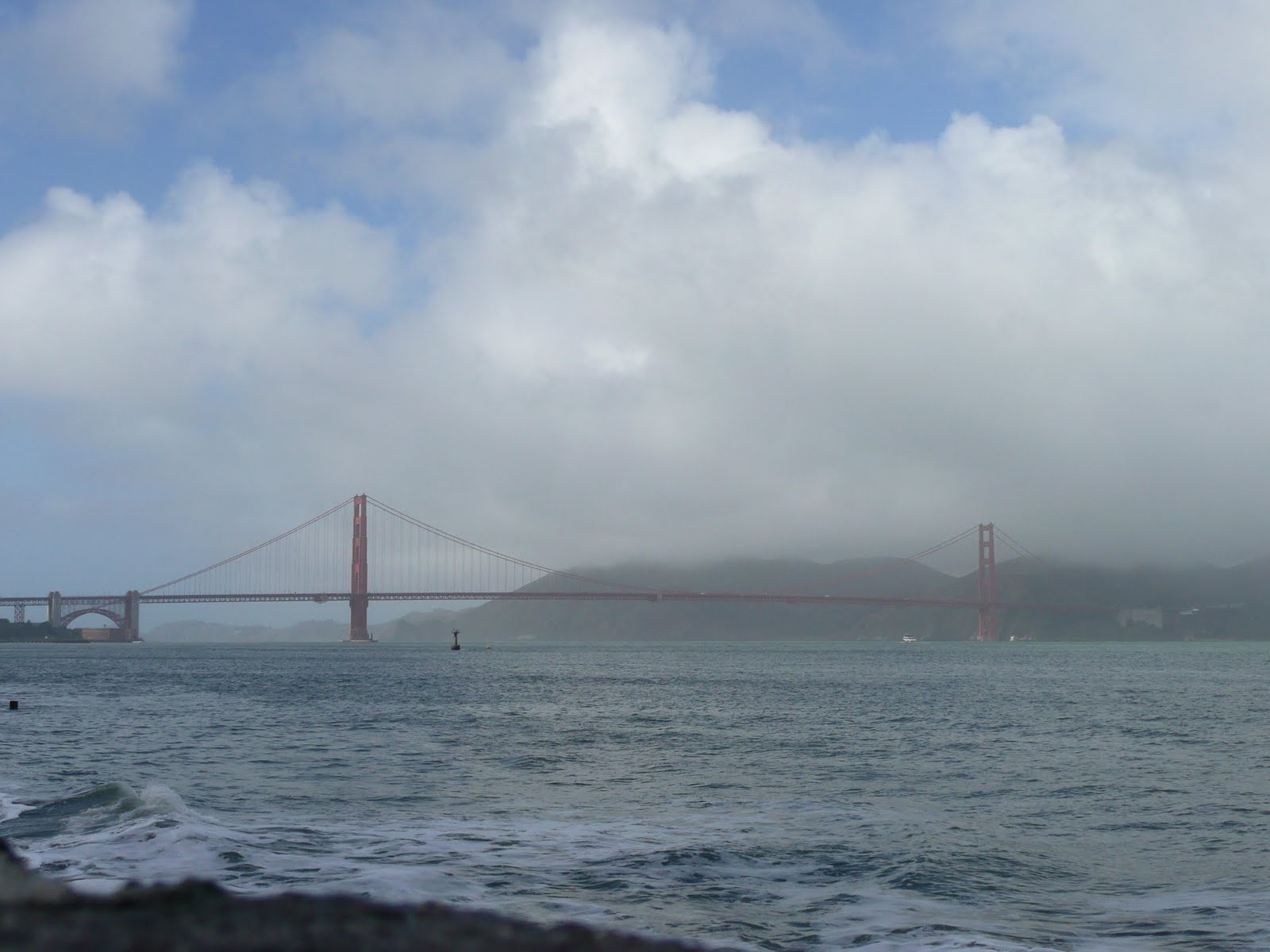
So I turned up after the pre-dawn drive from San Jose through downtown San Francisco and over the Golden Gate Bridge wanting a good training run. And a win. Oh, and a course record would be nice too, but the 7h03m time set last year was by one of the top US ultrarunners.
It starts on Rodeo Beach, just like Miwok, but goes the opposite direction, with the hardest section of Miwok as the start. Which means doing that steep up and down four times, being each way on each lap. But that's not the only hard section and basically the whole course is like that.
The weather was perfect for running with mist and clouds but no rain or heat. This made the first climb more comfortable and I sat back just behind a couple of guys to the top. By the time we started going down the trails I overtook them as they were being fairly cautious. Although I'd hoped to have people to run with, I then spent the rest of the day on my own, only seeing other racers on the way back from each out and back. At one point I ran along with Devon Crosby-Helms who happened to be out on her local trails after being pulled out of Western States just over half-way, meaning she didn't get any points and so didn't win the Montrail Ultra Cup.
At halfway I'd manged to not get lost even once and at least had the whole course in my memory so it would be unlikely I'd miss a turning. I had about a 10-minute lead and went through in 3h26m, comfortably under course record pace for the shorter, flatter course. However, I had tired legs and had probably pushed a bit too much. But with Western States still not completely out my system, I think I was always bound to slow down.
The second half involved more walking on the hills with walking breaks being minutes long, not seconds. But at each out and back I could tell I was gaining a bit more time on the rest of the field. The last out and back gave me around a 30-minute lead on second and around an hour on third, which surprised me. I'd slowed but clearly the unrelenting hills were taking a toll on everyone. I finished in 7h25m, just under four hours for lap two. Not ideal pacing, but I don't think there was much I could have done about it on fatigued legs.
The course was well marked and the aid stations were generally well stocked, although some weren't ready the first time I came round and it was lucky I'd brought my own gels and water backpack. I couldn't enjoy the scenery as much as at Miwok as I put more effort in and it wasn't full of sunny vistas. In fact, every hill-top was in mist the whole time I was out there, which was cooling but meant the views were blocked.
Weirdly enough it turned out to be good speed work, even with the big positive split. I flew down some of the steep, technical sections at sub 5-minute mile pace on lap one, and cruised down the easier downhills around 5:30 pace. That's probably why I'm so sore a day later, but it felt more comfortable than it used to. Just wish I could do that on the flat.
It was a race I'd recommend with most of the benefits of Miwok except the lack of fanfare and without the stacked field. Plus no issues about needing to be lucky in the lottery to get in. It was perfect training for mountain races although no climb was bigger than 1,000ft (300m), so that doesn't compare to the non-stop climbs of some races which can be five or more times the size (that 7,000ft or 2,000m climb at Transalps last year springs to mind). If I keep doing this stuff it should get easier and I'll have calves like Popeye's.
I didn't quite get into the zone and have fun, but once I'm recovered I'll be able to do that again. San Francisco marathon is next up in a week and it'll be fun to get an elite start there and some VIP treatment. I just hope I can run with some vague pace to justify it.
Monday, 12 July 2010
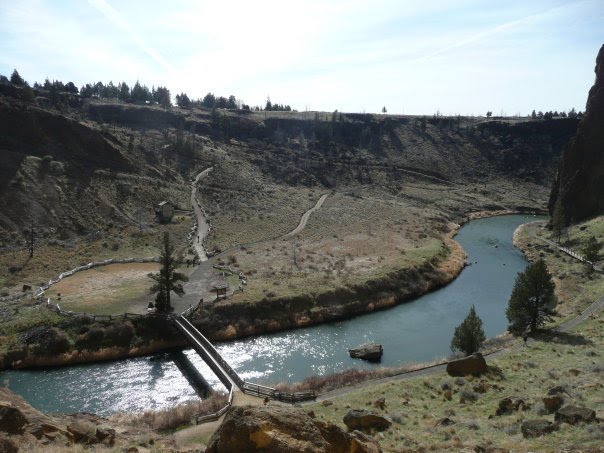
Something a bit shorter - Smith Rock Half
Monday, 5 July 2010
Reflection - one week after Western States
When I finished I was generally exhausted and not too keen on doing that to myself again. It felt so slow to run all day long and even have walking breaks, but I learned some valuable lessons for future 100s. Yes, there will definitely be plenty more since I didn't screw it up and it is satisfying to complete longer distances.
It wasn't as fun as running shorter ultras and I'm pretty sure that the 56 miles of Comrades is about the optimum distance for me, as well as the most enjoyable. Although 100k (62.2 miles) would also fit in with that, which is lucky since I was honoured to be offered a place in the GB 100k team a few days ago. I can't make it this year due to work and next year the World Championships are at Winschoten in the Netherlands, but are two weeks after UTMB. So maybe not even next year for my debut representing my country, but I'm only 29 so have plenty of time to fit it in (not normally the way I think about races I have to admit and I'd rather fit in every race going this year if I could).
Ultrarunning is a funny world. The World/European etc Championships are very low key and attract a decent, but not always outstanding field. Comrades has a much higher standard and the male and female winner would only have to jog (almost walk) the remaining 10k or so to get a time which would win the World Championships.
And for trail running, there's high quality shorter races organised as Sky Races and World Cups but beyond the marathon there're no meaningful Championship races. Instead, races like WS, UTMB or Davos become the equivalent of the Marathon Majors to the marathon world - the best come to race even though there's no title (or much money for the ultras). That's why this year's WS did shine in one definite respect - it attracted a large number of, arguably, the world's best ultra trail runners. It felt like a championship, and not just a North American one thanks to Killian Journet. Being part of that was something special and something I want to repeat, plus the silver buckle was nice.
I've said it before, but I'd rather race against the best and see where I stand than win a race with no competition. There's something very appealing about testing yourself against not only a course or time, but against other people. That's why I think I'll have to run Comrades forever and will turn up to WS frequently too. UTMB should be a good option next year and one other race I haven't mentioned - the North Face Challenge 50-mile Championship Final in San Fran in December. The latter has the biggest ultra prize purse outside of Comrades and, maybe, Two Oceans - $10k for 1st. So it attracts hot competition and is conveniently local for me now. Definitely worth focusing on over winter. Hopefully I'll see plenty of familiar faces there.
Monday, 28 June 2010
Western States Endurance Run - The last 38 miles (the hard bit)
Sunday, 27 June 2010
Western States Endurance Run - The first 62 miles
Thursday, 24 June 2010
Pre-WS
Sunday, 13 June 2010
Dirty Half makes for a great US trail championship
Summer started in Bend on the Saturday after a long period of generally crappy weather but the conditions on race day were perfect with the recent rain making the course less dusty. It starts off with a few miles of uphill, levels off around five miles, then undulates before descending again and throwing in some more hills near the end with a total elevation change of +/-1,000ft.
The guys at the front went off fairly fast and I didn't see them again after about a mile. For me, the aim was to run hard and get in a great training session on relatively easy trails. The legs are still feeling Comrades and I could tell within the first minute that they had no pace in them, especially for the uphills.
I wanted to have an enjoyable day and most of it was...except the actual running bit. The tired legs meant I was breathing hard and going slow enough uphill to have people overtake me easily. But with it having plenty of downhill in the second half, I aimed to push and get the heart rate up higher than in all the marathons and ultras. This almost ended with me having to walk or at least slow down to a gentle jog because I started sprinting downhill before seven miles and the legs felt extremely wobbly with a lot of miles left. But I spent the time from five miles in going past people and got up to eighth by nine miles then couldn't see anyone again til the last half mile. Seventh was too far ahead but it gave me an extra incentive to push and meant I got in a great training session.
Max King won by over a minute in just under 1h11m and was almost a minute per mile ahead of me, in 1h21m. It's a great race, although trying to race it on tired legs wasn't as much fun. Excellent organisation, as ever, by Footzone and it reminds me of why Bend's such a great place to live, especially for runners.
No more races until Western States in 13 days. Am guessing I'll need another session of Active Release Technique work for the knee, but that should be long enough to recover and be in reasonable shape. As long as I can get a place, 2011 will probably be the year I can race it really hard and this year will need to be a learning experience (not that I won't try to be near the front).
Now I need a lie down. These half marathons are knackering.
Saturday, 12 June 2010
Squeezing in the Newport Marathon on the Oregon Coast
With Comrades only six days earlier, plus 40 hours of flights and airports to get back from it, I was still a bit crippled. The left knee soreness I've had on and off was making me limp badly for the first two days after the ultra, but the recovery compression tights were on the whole time, including the long journey home and I felt just plain sore in the muscles by the time I landed. Comrades always destroys my legs much more than trail races thanks to the faster pace and hard road surfaces, but I was able to do short, very light jogs by Thursday.
Friday was another very short, very slow jog and I didn't feel prepared to run further than about five miles. I only entered the Oregonian marathon on the off chance I'd be ok to jog it, so if I had to DNS, so be it. But I lined up on race day in bright sunshine with knee-high, compression socks on. Given the race didn't count, this was the time to try new stuff out and the compression tights seemed to work, so why not give the school-girl-style socks a go too. Paula Radcliffe uses them and she seems to know what she's doing, even if it makes her look silly.
I jogged off with the 800-strong field along the coastline and felt reasonably good going at 3h marathon pace, but decided to opt for a gentler 3h09m time since I like filling in marathon times I haven't got before (I need 3h10m, 3h09m, 3h00m and most times below 2h45m to get the full set of Boston marathon qualifiers). It gives me something to aim for and allows me to practice my pacing, which really helps in the ultras, especially.
Amy was at the 11 mile aid station, which was really just a farm offering oyster shots and didn't even have water. The course then went out-and-back so that the same point was also just before 20 miles. It's a fast course and virtually flat so the perfect weather meant it was a really enjoyable long run. I chatted to a few people and it's always good to see the whole field coming the other way on out-and-backs, which lots of smiles and encouraging words.
I jogged it in to the finish for 3h09m18s, just as planned. This time I cheated a bit, because I didn't do an even pace, but instead did 1h30m for the first half in case my legs lost all energy near the end. But I felt fine at the finish, even after the oyster shots. A fun day out and a chance to see a beautiful part of the state I'd not been too. I thought I was doing well to be able to keep up a reasonable pace for a marathon so soon after Comrades, then I noticed that Mike Wardian managed a 2nd place in the North Face 50 miler in Virginia the same weekend after going the same pace as me at Comrades. That adds to his nine or so (comfortably) sub 2h30m marathons and several longer races (like 3rd in the MdS) just in 2010. I thought I had fast recovery and didn't taper but he rewrites the book on marathoning.
Anyway, that was my last long run before Western States on the 26th. I just have to keep everything in working order since it's too late to improve my fitness now. This weekend (on the 13th) has the US trail running half marathon championship, conveniently in Bend. So that's my last race and a chance for speed work now my legs are probably, maybe, recovered from Comrades.
I'm getting the fear about doing the longest, hardest, hottest race I've ever tried and wishing I could have fitted in more big hilly trails. I'm even sitting in a sauna each day to acclimatise to the heat, although this is the least enjoyable training I've ever done. I hope the race is worth it and this could be where I decide whether or not I want to focus on 100-milers or not. I hope so, since there are so many great ones in the world and it's the best ways to see some of the most remote places around (well, in developed countries anyway).
Wednesday, 2 June 2010
Giving it everthing at Comrades 2010
This time I had more friends coming over from the UK and Ireland and the fact that the race was much bigger than previous years meant I knew a lot more people who were running. The organisers had convinced everyone that 2010 would be special due to the FIFA World Cup being in South Africa two weeks later plus it being the 85th running of the race. I can see that the former meant the world spotlight was on the country but the latter reason seemed a bit dubious. However, the marketing had paid off and the race had sold out very quickly and had double the number of entrants in a typical year, with around 24,000 signed up. It also promised to be the Guinness Record for the biggest ultra in the world...but one thing I’ve learnt about Guinness is that any non-professional records are often dodgy (like all my weird records). In 2000 there were over 20,000 finishers at Comrades, but Guinness weren’t there to certify it so whatever the number in 2010, there would be a ‘record’ even with the Comrades organisers admitting it would be the second largest race in history.
But never mind the technicalities, it was billed to be something even more amazing than usual and I was very excited in the build up. I had some left knee niggles in the couple of weeks before race day, but these proved to be unimportant (they may be more significant for Western States since my knee is currently buggered, but I’m writing this just a day after the run so there’s bound to be aches and pains).
Comrades is the most elite ultra in the world, bar none. The quality of the field for the 89.3km (55.5 miles) is better than any other by far and includes ex-Olympians. Previous winners include running legends from South Africa, obviously, plus Alberto Salazar (quoted saying it was his best win) and Ann Trason. They were the only American winners in the race’s history but there had been two male Brits winning as well, back in the 60’s and 70’s. No British women had won. So I’d set myself the ambitious goal of getting a sub six-hour time, which I don’t think had been done by a Brit since that last win in the 70’s.
It would have been easier if it wasn’t for the hilliness of the course, but I’ve done it three times, with two in the downhill direction from Pietermaritzburg to Durban (4,700ft of climb, 6,600ft of descent) and one in the other direction (with opposite elevation changes). 2010 was another down run, making it two in a row instead of the usual alternating annually. I’m not sure why this was but it allowed the marketing people to offer a ‘double down’ medal to first timers (‘novices’ in Comrades-speak) in 2009 who came back.
Never have I wanted a result more, since breaking six hours gets a particular, rare medal – the Wally Hayward medal. Comrades has a lot of unique features, which I’ve mentioned previously, but one which is a real motivator for a lot of people is the medal system. There are different medals for the top 10 men and women (gold), sub 6h (Wally Hayward), sub 7h30m (silver), sub 9h (Bill Rowan), sub 11h (bronze) and the final cut-off of 12 hours (Vic Clapham). Some of those medals are named after previous winners. Bill Rowan was the first winner in 1921 and did it in 8h59m, so those breaking 9h are beating the time of the first winner. But my medal was named after Wally who was the first to break 6h as well as managing wins in the race 20 years apart.
My Durban friends were in attendance as usual and I stayed with Peter Pearse and his wife Annette. He was meant to be running but had been off-form in the recent Two Oceans marathon so decided to crew for me instead (‘seconding’ for me, as it’s referred to at Comrades). Another friend, Paddy, had also meant to be running but had just had eye surgery which wasn’t healing fast enough to allow him to get to the start line, so he also joined my seconding team.
Race morning started stupidly early, as always. I was up at 3:30 then we were off shortly afterwards with Peter’s brother, Mark, also in the car and going for his 12th finish. Both of us were running for Kearsney Striders, a club based along the route with a maroon kit, in the same flimsy style as all male Saffer kits. We got there slightly later than planned and when I jogged from the car to the ‘A’ seeding pen I only squeezed in with a minute to spare, at 5:14. The pens were closed at 5:15 and music blared out into the huge crowd of runners and spectators in the pre-dawn, flood-lit blackness. It was a little chilly but promised to be good running conditions and not peak at a hot temperature.
Some people bounced up and down with the beats, some stretched with focused gazes, but all looked excited. It was the moment I’d been waiting for for a whole year since the finish line in 2009. Only a thunder cloud can emulate the electric atmosphere of a Comrades start line and there was palpable nervousness and anticipation in the air. I bumped into some friends just as we got closer to the 5:30 kick-off and I could see they were as up for it as me. We had the two iconic songs which epitomise the race for me – the local song ‘Shosholoza’, which I think has mining roots, and Chariots of Fire. Both permeated through my bones and I stopped bouncing around and stood transfixed on the invisible horizon as I thought about the task ahead.
It’s easy to aim for a time and to concoct a training plan which you think will get you there, but in those seconds before the starting cock crow and gunshot I fully appreciated what I was about to attempt. I’d have to run near to my marathon pace up and down big hills for six hours, averaging four minutes per km, or 2h50m per marathon. I’d also have to knock off 30 minutes from my 2009 time and that race had been near perfect for my shape on the day. So for just a few seconds I took a deep breath to set me up for the task ahead. A task which I’d talked up for months and which I finally had to back up actions. I wanted the challenge and knew I was in good enough condition to do it, but I’d have to absolutely nail my tactics. There could be no room for error, I’d have to push harder than ever before and I’d need a portion of luck. This day was a big, big deal to me.
So, no pressure then, eh? As that gun went off I just went over the start line in the mass of runners and settled into a pace which felt ok. After a few minutes I could check to see what that pace was, but I wouldn’t be adjusting it for a few kms until I’d warmed up. It was pitch black apart from the street lights and it felt like the usual midnight riot as we charged along the streets of Pietermaritzburg. Lunatic runners shot off like they only had a 10k to run. I allowed the crowds to surge past me and didn’t let them upset my pacing. Then I saw Kami Semick after a few minutes and had a quick chat before wishing her luck in her attempt at a gold medal before I went off ahead to start aiming for the pace I’d need to sustain all morning. There were three other top Americans running as well so there were potentially four gold medals which might head back over the Atlantic.
The supporters were well wrapped up in the morning cold but I was just about warm enough from the running. Many were huddled around fires and I loved the commitment for them to get up so early to watch the hordes of runners stream past and send us off on our epic day. I know the kids will remember it for the rest of their lives and that many will reach that start line themselves and think back to their first memories of the race and how it became an annual tradition to be involved.
But while they cheered I was finding things tough. That’s not the ideal start to the race when it’s such a long one, but I just couldn’t stick to the pace I’d planned on without it feeling really hard. You can’t push the pace early and feel like you’re racing in an ultra and need to generally get at least half way without it feeling too strenuous. But I felt like the constant climbs (the first 20kms are predominantly uphill to the highest point at Umlaas Road except for the killer downhill of Polly Shortts) and cold were making four minute kms feel like marathon pace, which is not sustainable for an entire morning.
Soon after the sun rose I saw Peter and Paddy in Ashburton at 15kms after a particularly challenging hill and told them that things were looking bad and that 6h10m-6h15m was a more likely target. I was three minutes over pace after that first hour and it hadn’t felt easy so I was probably being optimistic even telling them that timeframe. It’s always hard to predict how an ultra will go early on, but you can get a feel from the first miles. All you can do is keep running and see how it goes.
The day rolled on and I caught up to the gold medal position women. After passing third place (a Russian lady, unsurprisingly, since they’ve dominated the ladies’ race, in particular), I decided that it would be more sensible to change my target to chasing down the Nurgalieva twins who have won most of the Comrades runs this century, usually around 6h10m. It helps to have something to focus on and I just didn’t think there was any chance of gaining the lost time back, even if I could get back on the required pace. The hills were proving too much of a drain and were slowing me down more than I’d planned on. They don’t relent and even the down run has significant climbs other than the five major, named hills. It may end at sea level, but it still totals 1,400m (4,700ft) of ascent. Not much for a trail race but a lot when compared to fast road races and enough to make it noticeably harder on the legs than a flat race of the same distance.
Somehow my legs seemed to warm up and start functioning better so that as I went through nearer to halfway, I was comfortably clocking kms just under the four minute pace I needed. It seemed quick but my breathing was relaxed so I just knocked out the distance and saw Paddy and Peter a couple more times before the first major uphill of Inchanga, which started at 39km in. I was able to let them know that things had improved and that I was maybe back in with a shot of the finish time they were expecting.
Inchanga was a beast, as always, but I managed to keep up a fair pace and pass people, especially those on walking breaks. The sun was out but it wasn’t too hot and there was a light breeze to keep it comfortable. Just after the top was the ‘47km to go’ marker, meaning 42.28km had been completed – a fraction over a marathon. I hit it around 2h51m. I could hear the speakers and MC at halfway from around a km away so I heard them announce the Russian twins going through just under 2h59m. That’s course record pace (5h54m for women) since the halfway mark is marginally over the true halfway by around 400m and faster than they’ve gone before. But at least I had an idea of where they were now as I went through in 3h02m.
It was a relief to go through the halfway corridor of balloons and Flora advertising boards and to be on a good pace, feeling fine. I’d told myself in advance that a negative split would be possible, like in 2009, and that I’d still be in with a shot of six hours if I went through in under 3h03m. But I’d hoped to not be too close to that time. In the year leading up to the race I’d heaped pressure on myself to improve and had made sure I let people know what my aim was, so that it would be more motivating and easier to stick to the training. At three hours into the race I seemed to be living up to the run I knew I had the fitness to pull off, but there was still the hardest part left and any problems could still add buckets of time to my finish.
Next was the long, hard climb from halfway up Alverstone and up the third big hill, called Botha’s. This is probably the hardest climb of the day on the down run as it’s far enough in that the legs are tired and has multiple climbs which sap the energy out of the legs. As I passed the ‘42km to go’ sign I saw I had exactly 2h48m to break six. Dead on four minute kms and the course is a big net downhill from that point, losing almost 2,300ft to Durban. Paddy and Peter saw me and handed me another gel, which helped, but my calves started screaming at me on that long climb.
Luckily one of the highlights of the course was up next. With around 38km to go there’s Kearsney College, the home of the Striders who I was running for. As I had a local kit on, I got a lot of extra support from those living in the area, mixed in with some surprise that one of the Striders was relatively near the front with the pros. The kit has lots of tiny white dogs on it and I have to admit I’m not sure the significance of dogs to the club, but it gives some supporters an opportunity to shout at me ‘Who let the dogs out?’ in various states of drunkenness while they sit by their braais (barbeques) lining the street. Another surprise around this point was passing the elite US marathoner, Josh Cox, who had aimed to win, but I went past him with 37 kms to go and he was walking (he finished in 6h51m, so did get running again, but his heart can’t have been in it any more).
As happened last year, I was handed a balloon shortly before the college so that the lines of school boys would see their runners coming and cheer loudly. In 2009 this had been a real pick-me-up and saved my race, but this time round I was already going well, even if my legs were complaining a lot more sharply than before. High fives were exchanged along the line of kids and I couldn’t help having a bit more spring in my step.
The next time I was due to see Peter and Paddy was soon after, around Hillcrest, where Peter lives. The support was most vocal over these kms due to the proximity to the college and I also saw Peter’s wife, Nets, and daughter, Em, around here. I only just caught them in the thick crowds and if people didn’t shout my name I had no chance of spotting them. This is a relatively flat section and I was flying, but trying to save something for the longest downhill of the day on Field’s Hill, from about 25km to go.
Finally I caught sight of the Nurgalieva twins ahead and a few guys who were sticking with them for pacing. I’d expected to see them within the first 10km, but they’d really pushed the start and opened up an unsurpassable lead in the ladies’ race. At 26km to go I was in their ‘bus’ (as a pack is called over there), watching their unmistakable waddling style of running and the lead car with cameras and entourage attached. I’d planned to run with them for a bit, just for the novelty of running with race leaders in a professional race, but they’d slowed from their initial cheetah pace. I only ran with them for about 100m before deciding they were going too slowly and would upset my time goal since they clearly weren’t going to make six hours this time and were running about 15 seconds per km slower than I wanted.
So I pushed on again and soon hit Field’s Hill after a couple of bridge crossings over the M13 highway. I couldn’t see the twins behind me and the runners were now very well spaced so I could barely see a single runner ahead or behind. From this point the aim is always to catch all those people who went out too fast and I was gradually catching each runner who came into view.
The hill lasted almost four kms and really pounded the thighs. Some guys were walking down it, and these were speedy runners. The big danger in the race is to run Field’s too hard and end up with exactly a half marathon left but no legs to do it on. For many, this is the hardest section, but I always look forward to a chance to catch up some time. I’d lost maybe a minute from the climbs in the second half, so wanted to use the downhill to catch this up, plus a bit extra, then I’d still be needing the four minute kms for the last 21km. If it had been dead flat, I think this would have been possible, but at the bottom of the hill I could feel that my thighs were causing almost as much tight soreness as my calves had for a while.
I had a decision to make – to go for the 1h24m final half marathon and hold nothing back or to just jog it in and accept a slower, easier time, but still aiming to beat the twins. Since I’d already gone through several decision points in the previous hours and had cranked it up each time, it was a foregone conclusion which I’d choose. Motivation was the key now. How badly did I want it? One question showed me the way forward – could I live with a half-arsed attempt once I finished? If I felt I hadn’t given every last drop from my heart, I knew I’d have to think about it until I returned to the race. But if I used the after-burners all the way, I’d know I’d given it my all and could be satisfied.
The fatigue and pain was making me more emotional, as was the elevated heart rate from the higher effort level. Suddenly I knocked out the pace I would need for a few kms through Pinetown. If I just took it 5km at a time, maybe I’d make it. This soon switched to taking it every km at a time as I needed immediate feedback and targets to stop me dropping off at all.
Unfortunately, the task then became harder with Cowies Hill looming ahead. Although not the biggest hill, it is steep and added more seconds to a km which would mean all the remainder would need to be faster. Doubt crept in again as the task seemed impossible. I was going as fast as I could and barely breaking the four minute kms, but would now need to eat away at the additional time added on in the last few uphills.
The road kept going and I didn’t slow down as it was generally flat or easy terrain. Paddy and Peter were at 12km to go and gave me my last two gels. The first one went down immediately and gave me a huge boost with a faster km. Another fast km followed it and I saw I’d have 38m30s to do the last 10k. Doubt entered my mind again, but all I could do was take what I could from the day. Maybe I couldn’t run almost six minute/mile pace to the end and maybe I could, but I was definitely going to try.
That’s exactly what I did for a km and I started to believe I might actually pull off my target time. I’d never have believe it after the first hour of running, but I’d pulled things back to this point. However, Comrades wasn’t going to be kind to me and out came one of the nasty, sharp and unnamed hills which I’d completely forgotten about, at 45th Cutting. What needed to be fast was instead a hard slog uphill and meant I’d need to get around the speed of my 10k personal best for the last 8kms. I’m an optimist, but not enough to think I can finish an ultra with a fresh-legged 10k time. From this point I knew the finishing time would start with a ‘six’.
But what’s the point of wasting a hard day’s work? I kept on hammering along as if that slow km hadn’t happened and it paid off with an unexpected twist near the end. Of the two elite male runners from the US, I’d passed Josh Cox earlier but not seen Mike Wardian. I thought he might be in amongst the gold medallists, but then I caught sight of him at 6km to go. Given I’d not seen him before, it meant I was catching him so I had one last incentive – to overtake him. He was still passing other runners, but they were all so spread out and it took me a km to catch him. I said hi but was unable to manage much of a chat and he clearly didn’t want to be overtaken by a white boy (only two guys ahead of us at this point were white and both were Russian ex-winners), so sped up.
I had just enough left in me to go clear of Mike (he finished just over a minute behind me), then I could only see two more people ahead on the long straight on Pine Street, so set off after them to take my mind off the cramped, screaming muscles. On the final turn I caught the last of them and I could barely hear the roar of the crowd as the cricket stadium lay ahead with the finish. Looking at my watch, I’d almost got under six hours, but instead I heard the countdown for the Wally Hayward medal cut-off just as I started running round the inner side of the cricket ground and before I broke inside on to the grass. Each cut-off time on the finish has the race director face away from the runners, do a countdown then fire a pistol. I was nowhere near but was still the only one in the stadium, making me the first of the silver medals – a dubious honour.
My friend and one of the race commentators, Helen Lucre, later told me that she’d had a minute or so of TV footage focused on me as I ran through the stadium and missed the medal cut-off by 73 seconds, so I’ll have to look that up. But it was a victory for me as I ran my best ever race, the hardest effort of my life. I didn’t get the time I wanted but I was within spitting distance of it. And I did a negative split, overtaking people non-stop from about 90 minutes into the race and not being passed once from then. 24th overall, out of over 16,000 starters is something I’ll treasure...until next time as I know I can go much faster (but not until I’m better trained and definitely not this time around). As ever, the race left me more highly motivated than before and with a desire to reach the highest level I can. I’ll never forget it and I’ll return every single time I can. My addiction to Comrades is total, but also totally understandable to those who’ve ever been part of the race.
Kami finished 4th for the ladies race in 6h32m and Lizzy Hawker from the UK was 6th in 6h39m (both are past 100km World Champions). The Nurgalieva twins finished within a second of each other in 6h13m and Stephen Muzinghi of Zimbabwe won his second consecutive Comrades in 5h29m, with the last male gold medal being 5h48m, just 13 minutes ahead of me...