I think the smartest running decision I've made was to DNF Rocky Raccoon this February. I can now appreciate that much more now I really see what it feels like to be overtrained.
I thought I'd give the Redwood 50k a go this weekend even though I know I should be resting. Even though resting should only include very easy jogs every few days, I somehow thought a 50k on medium trails would be possible if I just took it easy. Maybe I'd even win since it's not generally a competitive race so nine minute miling generally is enough.
Since I've always been able to run a lot of races without too many negative effects, I thought the same would apply after my first 100 miler, but I should have allowed a bit more time to recover after Western States. I only had one weekend off before racing again, which was basically stupid. Even when I aim to run a race easily, I often push a bit too hard and that was the case then. I ran a half at full effort when feeling sore, then a 50-miler the next weekend at a reasonable effort, followed by all out at the San Francisco marathon (tired again) and then the next weekend was the Skyline 50k, which I ended up running hard towards the end when feeling tired again.
The Lore of Running by Tim Noakes has been very useful in understanding the physiology behind running and overtraining in particular. To most people, what I just tried to do was obviously too much, but I've got away with a lot so was willing to try it. I'll be more conservative in future, but only slightly. One thing which I've always gone by is I race according to how I feel and I've managed to avoid overtraining that way, but only just. A 100-miler needs a little more respect than a weekend off racing and I'll bear that in mind next time. Although, in fairness, I only ran the half because I felt ok to run, even though I shouldn't have raced it for the unnecessary win.
Anyway, I decided to drop after the 20k loop of the 50k today to allow for the recovery I obviously need. I ran the same course in May the day after a harder 50k and the week after the Miwok 100k yet it felt easy then. Today I went at the same speed (slow) but it felt noticeably harder. And that was after easy running for the two weeks since the Santa Rosa marathon (which also has a slight effect on my tiredness still).
Overall it's difficult to work out exactly what screwed me up, but the cumulative effect of so many hard efforts covers it overall. So after three miles today I just decided to jog, cruise in and call it a day at 12 miles instead of 31. I won;t run again until the Lake Tahoe triple on Friday and will see how I feel there since I really don't want to give up on that, since it's so fun. Mind you, I was really enjoying jogging through the fog and rain at Redwood Park today. I also really wanted to keep going since it's such a pretty course, but I had to drop to make sure I'd start fixing my heart and legs.
So now I know that five more days off running won't heal me, according to Noakes. Six weeks is required or more. So maybe I'll have to drop next weekend again, but I really hope not. I have to go for the really important races (the North Face 50 mile final in December then the Phoenix marathon in January) in a few months and if that means not running for six weeks then I'll do that, but someone may need to use a strait jacket to help me restrain myself.
Saturday, 18 September 2010


Thursday, 16 September 2010
Back to the trails but got to fix the overtraining syndrome

This is how I feel way too often right now.
1. Fatigue - fairly normal, but not all the time.
2. Sore legs - generally aching.
3. Lethargy - virtually every run, even a slow jog, feels like an effort.
4. Lack of enjoyment and desire to run - have been particularly uninspired recently.
5. Inability to do hard training sessions - I've tried but generally had to stop since it wasn't feeling right.
And the list goes on much longer. From reading the excellent 'Lore of Running' by Tim Noakes, I'm picking up some useful refinements to everything running related, but his chapter on overtraining was sober reading. Supposedly I'm at a stage now where it could be up to two months of virtually no training (and certainly nothing hard) to let my body rest and recover. That sounds like about the hardest type of training I've ever thought of. The idea of letting years of effort and improvement temporarily go, even for longer term benefit, is depressing.
So I'm now in a dilemma, except I already know the answer. Do I cut my running down to just the odd jog every few days until I start to feel really refreshed and normal again? Or do I still do the races I've entered over the next couple of months, at a rate of at least one a week? Well, I've paid for stuff and I also can't really afford to let the training completely go if I want to run well at either the North Face Championship in December or go for a marathon PB at Phoenix in January (never mind the need to get a lot of miles in for Rocky Raccoon's 100 miles of trails in early February).
I know everyone goes through injury periods and that overtraining is extremely common, even though people often ignore it (like I have). And I don't want to wreck my body and cut short a running life that I'm hoping will last around 60 years longer (sorry, Amy). So there's only one sensible way forward, although the use of the word sensible may be stretching it slightly - do the races really easily where possible but basically nothing else. I mean, I was tired in my last marathon a couple of weeks ago, but I still did my second quickest time and that was running solo the whole way. So there's something left in the tank.
But I'm going to reserve the right to DNF races where it just feels way too hard when I'm going slowly. Not because I'd worry about finishing, but because I'm worried about what it'll do to me after I finish. And I'll not run at all mid-week from now on until I feel better so I get the maximum recovery possible. It all starts this weekend with the Redwood 50k and the Quicksilver half marathon. Two very hilly trail races and I suspect I'll just about walk the latter for safety (but I've paid for the entry so I can still use the aid stations).
The following week may be tougher since it's the Tahoe triple marathon and I really want to get the win at this after second last year. Maybe just play that by ear and see where I stand after the first day of not going too hard.
All I know is it'll be really tough to not run, I'm going to have to start eating less and disengaging the competitive instincts could be about as easy as sawing off my own arm (like in the new Danny Boyle film). If I'm lucky I'll feel ok during the races and be able to enjoy them instead of struggling and also going slower. I know the stuff I did back in March/April was a lot of fun and that involved a lot of taking in the sights and running rather than racing. Two Oceans was one of the most fun events I've done because of the relaxed attitude I had to it, as was last year's Transalpine Run (which just happened this year again and I followed avidly and jealously online).
I hope everyone else is feeling more energised than me, but I look forward to waking up a bit if the reduction in mileage pays off. I'd be interested to hear any stories people have about overtraining or links to interesting articles/blogs. Thanks.
Sunday, 29 August 2010
Birthday(ish) marathon at Santa Rosa
After four weeks off and the small matter of a wedding and honeymoon, I decided it was time for a fast marathon. August has always been a month for marathon PBs for me (always at the Reykjavik marathon) so I wanted to keep that going and the only possible option was the Santa Rosa marathon in wine country, north of San Francisco. It's very flat and fast even with about 10 miles of gravelled paths to make the going a little tougher.
The last few weeks have been perfect but involved a lot of wedding cake, alcohol and lazing around by pools. A fun lifestyle and a great bit of relaxation, but not ideal marathon preparation.
I really wanted to get another PB and break 2:30, but it was never really on the cards. During the week I could barely run at marathon pace for a mile, never mind 26.2. So I thought I'd just go out fairly hard, see how close I could get to 1:15 at halfway of the two lap course, then try to hold on. Nice plan, but I had hoped to have some help on the first lap at least with some kind of pack. It didn't work out like that - the simultaneous half marathon had one guy shoot off but nobody else in either race went off below six minute miling so I was immediately on my own.
I've never run an entire marathon completely on my own and it was an interesting challenge. At least the conditions were perfect with no wind and cool temperatures. So I managed to hit 10k just over my 10k PB, break my 10 mile (57:40 now) and half (1:15:40 now) PBs then cling on to scrape in just under 2:36 for a season's best. The last eight miles were slower and I felt tired, partly due to overtraining, partly to lack of fitness from the last few weeks and partly to going out a little too fast for my fitness on the day.
I enjoyed most of it until I started struggling on the second lap. Going faster is fun and just one of the types of run that make up the whole package of the sport and make it so rewarding. I also had the bonus of winning by over nine minutes and getting prizes including a year's supply of bread (a bakery sponsors the race). Definitely a good day's work and a fun training run, even if not quite what I'd planned months ago when I optimistically thought I'd get more morning runs in during my honeymoon.
The run was a decent race, generally well organised and very flat and pretty fast. I got misdirected at the half way point and ended up running in the half marathon finish then asking the crowd/officials where the hell I should go (they didn't know) so I worked my way back to the race start and ended up adding about 0.2 miles on. Then I was almost tripped up as an official tried to move some cones on the course as I went past (when back on the proper route) and he swung one under my feet, hitting me. But small races get minor issues like these and it didn't affect my position or a PB so I can't really complain.
It was a shame to miss two of the biggest events this weekend - the Ultra Trail du Mont Blanc 103 miler in the French/Swiss/Italian Alps (all three countries in one race) and the World 50k Road Championships in Gibraltar. But UTMB ended up being cancelled due to weather with a 60 mile version taking it's place for a chunk of the field the day after and Gibraltar's course was supposedly slow and awkward. There's always a trade off with races and I wish I could be in three places at once (ideally for free), but the local race was worth it. And on the day before my 30th birthday I got in a good session.
The last few weeks have been perfect but involved a lot of wedding cake, alcohol and lazing around by pools. A fun lifestyle and a great bit of relaxation, but not ideal marathon preparation.
I really wanted to get another PB and break 2:30, but it was never really on the cards. During the week I could barely run at marathon pace for a mile, never mind 26.2. So I thought I'd just go out fairly hard, see how close I could get to 1:15 at halfway of the two lap course, then try to hold on. Nice plan, but I had hoped to have some help on the first lap at least with some kind of pack. It didn't work out like that - the simultaneous half marathon had one guy shoot off but nobody else in either race went off below six minute miling so I was immediately on my own.
I've never run an entire marathon completely on my own and it was an interesting challenge. At least the conditions were perfect with no wind and cool temperatures. So I managed to hit 10k just over my 10k PB, break my 10 mile (57:40 now) and half (1:15:40 now) PBs then cling on to scrape in just under 2:36 for a season's best. The last eight miles were slower and I felt tired, partly due to overtraining, partly to lack of fitness from the last few weeks and partly to going out a little too fast for my fitness on the day.
I enjoyed most of it until I started struggling on the second lap. Going faster is fun and just one of the types of run that make up the whole package of the sport and make it so rewarding. I also had the bonus of winning by over nine minutes and getting prizes including a year's supply of bread (a bakery sponsors the race). Definitely a good day's work and a fun training run, even if not quite what I'd planned months ago when I optimistically thought I'd get more morning runs in during my honeymoon.
The run was a decent race, generally well organised and very flat and pretty fast. I got misdirected at the half way point and ended up running in the half marathon finish then asking the crowd/officials where the hell I should go (they didn't know) so I worked my way back to the race start and ended up adding about 0.2 miles on. Then I was almost tripped up as an official tried to move some cones on the course as I went past (when back on the proper route) and he swung one under my feet, hitting me. But small races get minor issues like these and it didn't affect my position or a PB so I can't really complain.
It was a shame to miss two of the biggest events this weekend - the Ultra Trail du Mont Blanc 103 miler in the French/Swiss/Italian Alps (all three countries in one race) and the World 50k Road Championships in Gibraltar. But UTMB ended up being cancelled due to weather with a 60 mile version taking it's place for a chunk of the field the day after and Gibraltar's course was supposedly slow and awkward. There's always a trade off with races and I wish I could be in three places at once (ideally for free), but the local race was worth it. And on the day before my 30th birthday I got in a good session.
Sunday, 1 August 2010
Skyline 50k Trail Run

You know it's time to cut back when you stop loving running. The last week or so I've just been so tired and lethargic that I haven't enjoyed my training runs or had the energy to do much at all during the day.
I skipped my run yesterday and had no desire to get up this morning when the alarm went off at 5am. Mind you, that's not too unusual. But when there's a local, historic (29th year!) 50k trail run with just under 5,000ft of climbing to get up for, I'd generally feel at least a bit excited even in my sleepiness. I very nearly decided to not go.
Even when I started at 7am, I just wanted it to be over so that I'd have my long run in for the week and the last longer one for a month. That's not the way to think about it and defeats the point of running if there's no enjoyment. There was a pack of six guys, including me, who started pretty fast along the easy trail along the edge of Lake Chabot. Faster than I felt like going, but I knew that some fast times had been run on the course, with a CR under three hour marathon pace on trails and with a fair amount of ascent. I let myself sit behind the five guys who kept up the effort and gradually pulled away over a few miles until they were all strung out.
Each steep climb of a few hundred feet made my legs feel useless, but at least I had some energy for the flats and downhills. But it took about 10 miles to feel any sense of fun in the race and I was tempted to just stop earlier and give my body a rest as I didn't feel normal. Not ill, just not apathetic and wanting to call it a day.
Luckily there was some great single track and the course had great views through Redwood Regional Park. It overlapped the trail I'd seen at the Redwood 50k and was a joy to run. I was soon glad I'd got up early and felt better, although I still couldn't take the steep hills and walked a few small sections. So by around halfway I'd run a while near Chikara Omine and went past him on a downhill. I'd met him at the San Francisco marathon a week earlier, plus he'd been at Western States. In fact, four of the top five finishers had run Western States five weeks earlier, so it shows there's a great ultra pedigree in this part of the world.
From that point I ran completely alone with nobody visible ahead or behind. I ran hard and picked up the pace to see if I could improve on the third place I was in, but had no luck. So the race finished with last year's top four making up four of the top five and me squeezed in at third. Joe Binder improved on his second place in 2009 to win in 3h37m, then Jean Pommier in 3h43m, me in 3h46m, Chikara in 3h51m and Victor Ballesteros in 3h59m.
The post-race bbq gave me a chance to meet these guys plus a few more locals. It had been a lot of effort and I'm very happy I got a chance to do such a cool, fun race. However, it took a while to get into and I need a break from racing so I can feel that excitement again. Am really happy with the time I got too, but I'm glad it wasn't a road marathon as I wouldn't have had much pace and it wouldn't have gone as well as last weekend.
Luckily I get a forced break anyway with my wedding in a week, then honeymoon. So that's something to really enjoy and take my mind off racing for a few weeks. Then I can come back refreshed and with a passion to run again, just as it should be. Every ultrarunner I speak to absolutely loves getting out on the trails and I want to feel like I did at Miwok again, where I was running along, taking in the view and grinning from ear to ear.
I skipped my run yesterday and had no desire to get up this morning when the alarm went off at 5am. Mind you, that's not too unusual. But when there's a local, historic (29th year!) 50k trail run with just under 5,000ft of climbing to get up for, I'd generally feel at least a bit excited even in my sleepiness. I very nearly decided to not go.
Even when I started at 7am, I just wanted it to be over so that I'd have my long run in for the week and the last longer one for a month. That's not the way to think about it and defeats the point of running if there's no enjoyment. There was a pack of six guys, including me, who started pretty fast along the easy trail along the edge of Lake Chabot. Faster than I felt like going, but I knew that some fast times had been run on the course, with a CR under three hour marathon pace on trails and with a fair amount of ascent. I let myself sit behind the five guys who kept up the effort and gradually pulled away over a few miles until they were all strung out.
Each steep climb of a few hundred feet made my legs feel useless, but at least I had some energy for the flats and downhills. But it took about 10 miles to feel any sense of fun in the race and I was tempted to just stop earlier and give my body a rest as I didn't feel normal. Not ill, just not apathetic and wanting to call it a day.
Luckily there was some great single track and the course had great views through Redwood Regional Park. It overlapped the trail I'd seen at the Redwood 50k and was a joy to run. I was soon glad I'd got up early and felt better, although I still couldn't take the steep hills and walked a few small sections. So by around halfway I'd run a while near Chikara Omine and went past him on a downhill. I'd met him at the San Francisco marathon a week earlier, plus he'd been at Western States. In fact, four of the top five finishers had run Western States five weeks earlier, so it shows there's a great ultra pedigree in this part of the world.
From that point I ran completely alone with nobody visible ahead or behind. I ran hard and picked up the pace to see if I could improve on the third place I was in, but had no luck. So the race finished with last year's top four making up four of the top five and me squeezed in at third. Joe Binder improved on his second place in 2009 to win in 3h37m, then Jean Pommier in 3h43m, me in 3h46m, Chikara in 3h51m and Victor Ballesteros in 3h59m.
The post-race bbq gave me a chance to meet these guys plus a few more locals. It had been a lot of effort and I'm very happy I got a chance to do such a cool, fun race. However, it took a while to get into and I need a break from racing so I can feel that excitement again. Am really happy with the time I got too, but I'm glad it wasn't a road marathon as I wouldn't have had much pace and it wouldn't have gone as well as last weekend.
Luckily I get a forced break anyway with my wedding in a week, then honeymoon. So that's something to really enjoy and take my mind off racing for a few weeks. Then I can come back refreshed and with a passion to run again, just as it should be. Every ultrarunner I speak to absolutely loves getting out on the trails and I want to feel like I did at Miwok again, where I was running along, taking in the view and grinning from ear to ear.
Sunday, 25 July 2010
San Francisco Marathon
A fun, mainly scenic and tough marathon today around San Francisco. The city's marathon is one of the few road ones in July so had plenty of ultra-runners showing up who clearly had a free weekend. I saw Mike Wardian at the expo, fresh off his indoor marathon World Record of 2:27. I think even he's lost count of how many times he's run around that time even just this year and he was out for a win and a CR (standing at 2:26ish).
I've felt sluggish since Western States and have tried to do some speed work a few times but had to cut back to a jog when I felt there was nothing in the legs. Given I happened to be reading Tim Noakes' 'Lore of Running' recently, specifically the chapter on overtraining, I was trying to weigh up whether I'm just knackered from recent races or overtrained. There was only one way to tell - try to go hard in a race.
It started early at 5:30am and was chilly with the first few miles in pre-dawn darkness. I stayed in a cheap Travelodge and managed to get bitten all night by bed bugs so barely slept and won't be using their brand again. But by the time I started I felt fine and ran off with the others at the front of the start line, going too fast. I also managed to forget my watch or Garmin so had less idea of how well it was progressing.
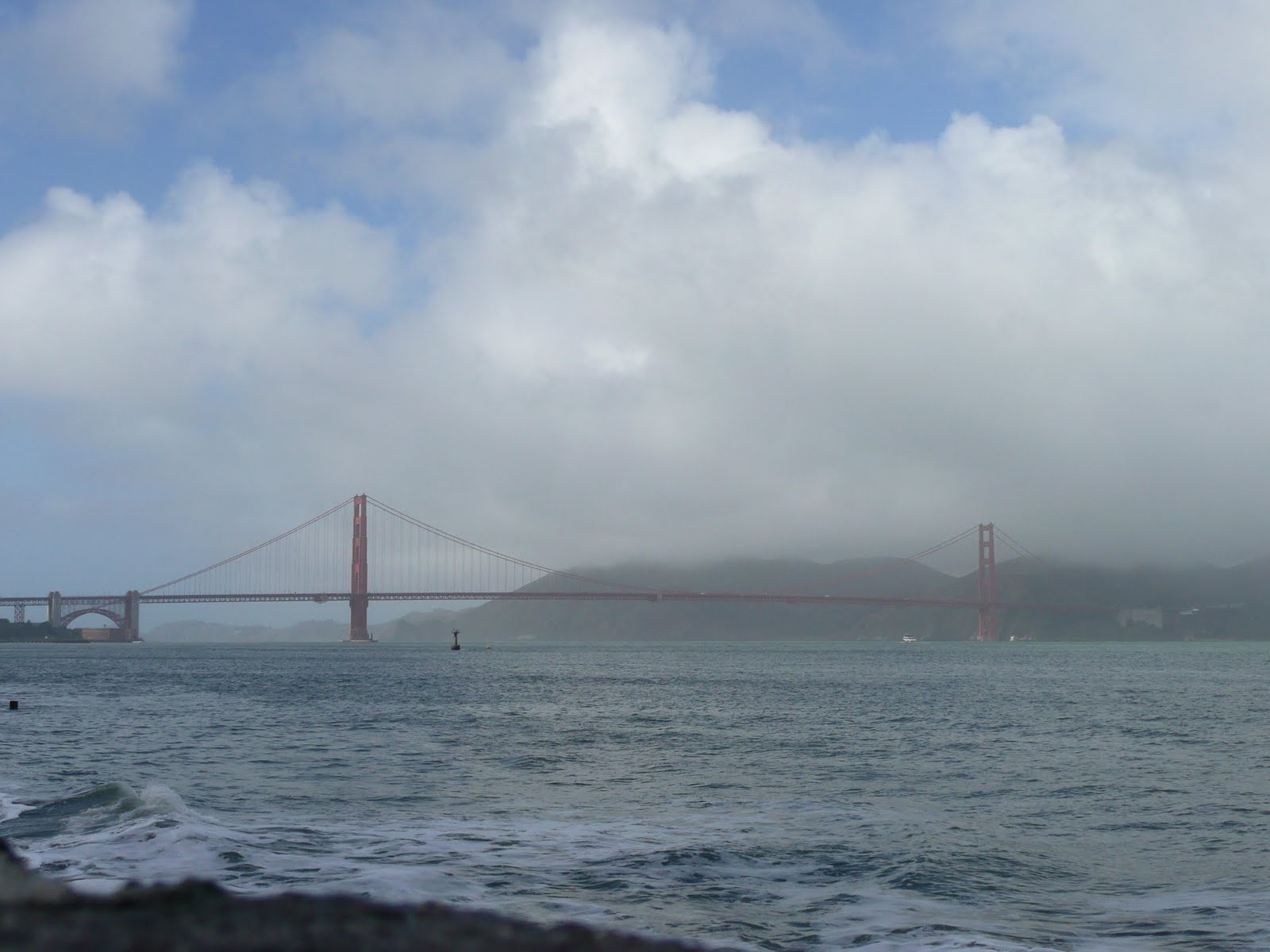
The course is fairly hilly and windy, with the first half having a particularly hard section up to the Golden Gate Bridge, over it and back. I tried to stay with a group of people and pace with them but it got strung out fairly soon around the top 20 and I had to run on my own. Running over the bridge was very cool, with a mist over it and everyone got to see the rest of the field coming the other way due to the out-and-back.
I got a time check at halfway and was pleased to see 1:18:30, which was better than I'd expected given the wind and undulation. Then the second half was flatter with more protection from the wind and I just tried to hang on even though I really felt less fresh than usual.
Overall it was a great race and I'm glad I was able to fit it in. I managed to just get a negative split, but that was mainly due to the second half being easier. 2:36:35 and 8th felt like a promising result and at least I seem to be knocking out ties around that frequently. Mike W broke the old course record with 2:25 but was pipped to the win by a couple of minutes. After chatting with others, we reckoned the course added maybe four minutes so he probably ran equivalent to near to his best time. The man is certainly consistent.
Definitely up for more of the same next year. I met a few local marathoners and ultra guys too so am glad about that. Although I do feel I missed out a bit on either the Lakelands 100 miler in England or 'The High' 100 miler in the Himalayas which were also this weekend. But every weekend is a compromise between all the amazing events which exist these days. Ultra-running is booming and that can only be good.
Sunday, 18 July 2010
Headlands 50 miler
 This year's course went through Tennessee Valley again and again and again.
Just back from another ultra and the first post-Western States. The Headlands 50 miler covers most of the same trails around the Marin Headlands as Miwok did and a whole load more races do too. There was also a marathon option with a 1.2 mile section added on to the start of the 25-mile lap.
This one was pure hills and a new course thanks to some road/trail work blocking off a section of the course. So instead of the accurately measured two-lap course with one out and back section, it was mainly the same but had an extra out and back bit so it looked more like the spokes of a wheel, centred on the Tennessee Valley Aid Station. And I'm sure it added a bit of distance too since each lap was almost 26 miles on the Garmin, which is usually accurate when there's no tree cover, as was the case.
So I turned up after the pre-dawn drive from San Jose through downtown San Francisco and over the Golden Gate Bridge wanting a good training run. And a win. Oh, and a course record would be nice too, but the 7h03m time set last year was by one of the top US ultrarunners.
It starts on Rodeo Beach, just like Miwok, but goes the opposite direction, with the hardest section of Miwok as the start. Which means doing that steep up and down four times, being each way on each lap. But that's not the only hard section and basically the whole course is like that.
The weather was perfect for running with mist and clouds but no rain or heat. This made the first climb more comfortable and I sat back just behind a couple of guys to the top. By the time we started going down the trails I overtook them as they were being fairly cautious. Although I'd hoped to have people to run with, I then spent the rest of the day on my own, only seeing other racers on the way back from each out and back. At one point I ran along with Devon Crosby-Helms who happened to be out on her local trails after being pulled out of Western States just over half-way, meaning she didn't get any points and so didn't win the Montrail Ultra Cup.
At halfway I'd manged to not get lost even once and at least had the whole course in my memory so it would be unlikely I'd miss a turning. I had about a 10-minute lead and went through in 3h26m, comfortably under course record pace for the shorter, flatter course. However, I had tired legs and had probably pushed a bit too much. But with Western States still not completely out my system, I think I was always bound to slow down.
The second half involved more walking on the hills with walking breaks being minutes long, not seconds. But at each out and back I could tell I was gaining a bit more time on the rest of the field. The last out and back gave me around a 30-minute lead on second and around an hour on third, which surprised me. I'd slowed but clearly the unrelenting hills were taking a toll on everyone. I finished in 7h25m, just under four hours for lap two. Not ideal pacing, but I don't think there was much I could have done about it on fatigued legs.
The course was well marked and the aid stations were generally well stocked, although some weren't ready the first time I came round and it was lucky I'd brought my own gels and water backpack. I couldn't enjoy the scenery as much as at Miwok as I put more effort in and it wasn't full of sunny vistas. In fact, every hill-top was in mist the whole time I was out there, which was cooling but meant the views were blocked.
Weirdly enough it turned out to be good speed work, even with the big positive split. I flew down some of the steep, technical sections at sub 5-minute mile pace on lap one, and cruised down the easier downhills around 5:30 pace. That's probably why I'm so sore a day later, but it felt more comfortable than it used to. Just wish I could do that on the flat.
It was a race I'd recommend with most of the benefits of Miwok except the lack of fanfare and without the stacked field. Plus no issues about needing to be lucky in the lottery to get in. It was perfect training for mountain races although no climb was bigger than 1,000ft (300m), so that doesn't compare to the non-stop climbs of some races which can be five or more times the size (that 7,000ft or 2,000m climb at Transalps last year springs to mind). If I keep doing this stuff it should get easier and I'll have calves like Popeye's.
I didn't quite get into the zone and have fun, but once I'm recovered I'll be able to do that again. San Francisco marathon is next up in a week and it'll be fun to get an elite start there and some VIP treatment. I just hope I can run with some vague pace to justify it.
Monday, 12 July 2010
Something a bit shorter - Smith Rock Half
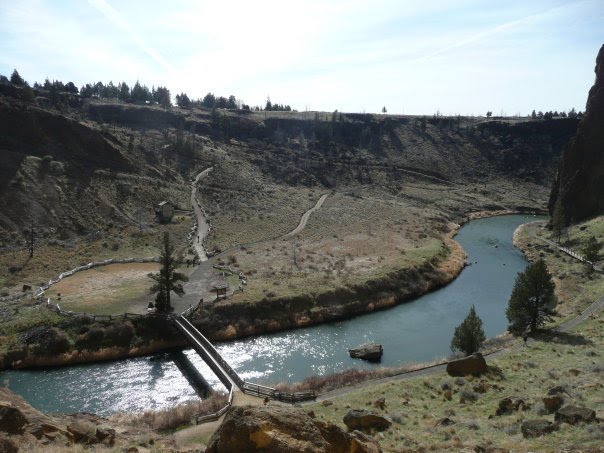 The view from part-way up Smith Rock's main trail.
 A nostalgic weekend but I managed to squeeze in a half marathon anyway to get my first post-WS race. I was back in Bend, OR, for the weekend to see Amy plus a fair chunk of her family, who were visiting. It's my last trip to Bend while still kind of living there (Amy moves at the end of the month to join me in San Jose) and the weather was perfect for summer fun and floating down the river.
Doing a half seemed a little anti-climactic after a 100-miler and with Badwater's 135-miler starting two days later, but I don't do many shorter races so it's good to mix it up. As I write this, Badwater is underway and I know a couple of people doing their first one, including James 'hallucinations' Adams. Rather them than me but I can completely understand the lure of such a ridiculously hard race. I better finish this write-up so I can get back to being the official Facebook poster for updates for James so people back in the UK know he's still going well.
However, the race that I cheekily squeezed in was the Smith Rock Sunrise Classic, a reasonably flat and fast half marathon in the shadow of Smith Rock, a famous hiking and climbing landmark north of Bend. As the name suggests, it was an early one with a 6:15am start, soon after sunrise. Definitely a great location and you wouldn't expect a flat race with Smith Rock in the name, but this one was well organised, fun and seems to be growing - there were around 340 finishers in the half plus more in the 5k and 10k.
I felt sluggish and had heavy legs with the 100-miler still leaving me less than fresh, so I thought I'd aim for somewhere around 1:17/1:18. That was good enough for the winner last year but I suspected that at least one of the local speedsters would show up to go way quicker. Plus I had tried a tempo run on the Wednesday and found that pace extremely difficult to maintain.
However, to my surprise I found myself running with one other guy at the start and plenty of footsteps just behind. But no obviously elite runners - 12 minutes for the first couple of miles would have been way too slow to be in the lead normally, especially as some guys were bound to go off too fast. So I just stayed in joint first until mile four before running ahead since the guy next to me kept varying his pace to zoom past me then slow down rapidly. I wasn't sure if it was a tactic or just a desire to keep recapturing the lead, but he faded after I kicked a bit anyway and finished well off the pace.
I'd hoped for a hard training run and got what I wanted. Keeping it around 6-minute miling was exhausting and my legs didn't have much in them. But I seemed to be gradually pulling away so had the incentive to keep going all out. As a consolation, I compared the hour and a bit of running here to the 17+ hours of WS and how an hour of pain isn't really that much.
Wind and slight inclines made my lungs burst but I had a good patch in the second half with a couple of 5:30 miles, which gave me a confidence boost that I haven't lost too much pace with all the recent ultras. It was also very cool to have my own police motorbike ahead of me to stop any traffic from squashing me. I've had a bike to follow in city marathons before, but never a cop.
I managed to hold on and get 1:18:05 for a win by about 1:40 and was very happy to have finished and won my first half marathon. This short stuff is a killer, although I don't usually mind this distance. I got an excellent training session in and it reminded me that it's time to start doing speed work again if I want to get that marathon time down below 2h30m. I think it's doable in a marathon at the end of August as I'll be nice and fresh and rested after my honeymoon and no races for the 4 weeks before it.
I'll miss Bend but at least I got a great last race in there before I left. I'll definitely have to come back for the odd long weekend and race since it's such a beautiful area. Next up is the very hilly Headlands 50 miler on Saturday then the San Fran marathon the week after, where I'd like to go a bit quicker than in this half to confirm that I'm in shape for a full pace marathon a month later.
Happy racing over summer everyone. So many beautiful races to choose from around the world.
Monday, 5 July 2010
Reflection - one week after Western States
Just a quickie now. It's been just over a week since WS and so it's sunk in and I'm running again after forcing myself not to for five days (was meant to be a week but I felt fine).
When I finished I was generally exhausted and not too keen on doing that to myself again. It felt so slow to run all day long and even have walking breaks, but I learned some valuable lessons for future 100s. Yes, there will definitely be plenty more since I didn't screw it up and it is satisfying to complete longer distances.
It wasn't as fun as running shorter ultras and I'm pretty sure that the 56 miles of Comrades is about the optimum distance for me, as well as the most enjoyable. Although 100k (62.2 miles) would also fit in with that, which is lucky since I was honoured to be offered a place in the GB 100k team a few days ago. I can't make it this year due to work and next year the World Championships are at Winschoten in the Netherlands, but are two weeks after UTMB. So maybe not even next year for my debut representing my country, but I'm only 29 so have plenty of time to fit it in (not normally the way I think about races I have to admit and I'd rather fit in every race going this year if I could).
Ultrarunning is a funny world. The World/European etc Championships are very low key and attract a decent, but not always outstanding field. Comrades has a much higher standard and the male and female winner would only have to jog (almost walk) the remaining 10k or so to get a time which would win the World Championships.
And for trail running, there's high quality shorter races organised as Sky Races and World Cups but beyond the marathon there're no meaningful Championship races. Instead, races like WS, UTMB or Davos become the equivalent of the Marathon Majors to the marathon world - the best come to race even though there's no title (or much money for the ultras). That's why this year's WS did shine in one definite respect - it attracted a large number of, arguably, the world's best ultra trail runners. It felt like a championship, and not just a North American one thanks to Killian Journet. Being part of that was something special and something I want to repeat, plus the silver buckle was nice.
I've said it before, but I'd rather race against the best and see where I stand than win a race with no competition. There's something very appealing about testing yourself against not only a course or time, but against other people. That's why I think I'll have to run Comrades forever and will turn up to WS frequently too. UTMB should be a good option next year and one other race I haven't mentioned - the North Face Challenge 50-mile Championship Final in San Fran in December. The latter has the biggest ultra prize purse outside of Comrades and, maybe, Two Oceans - $10k for 1st. So it attracts hot competition and is conveniently local for me now. Definitely worth focusing on over winter. Hopefully I'll see plenty of familiar faces there.
When I finished I was generally exhausted and not too keen on doing that to myself again. It felt so slow to run all day long and even have walking breaks, but I learned some valuable lessons for future 100s. Yes, there will definitely be plenty more since I didn't screw it up and it is satisfying to complete longer distances.
It wasn't as fun as running shorter ultras and I'm pretty sure that the 56 miles of Comrades is about the optimum distance for me, as well as the most enjoyable. Although 100k (62.2 miles) would also fit in with that, which is lucky since I was honoured to be offered a place in the GB 100k team a few days ago. I can't make it this year due to work and next year the World Championships are at Winschoten in the Netherlands, but are two weeks after UTMB. So maybe not even next year for my debut representing my country, but I'm only 29 so have plenty of time to fit it in (not normally the way I think about races I have to admit and I'd rather fit in every race going this year if I could).
Ultrarunning is a funny world. The World/European etc Championships are very low key and attract a decent, but not always outstanding field. Comrades has a much higher standard and the male and female winner would only have to jog (almost walk) the remaining 10k or so to get a time which would win the World Championships.
And for trail running, there's high quality shorter races organised as Sky Races and World Cups but beyond the marathon there're no meaningful Championship races. Instead, races like WS, UTMB or Davos become the equivalent of the Marathon Majors to the marathon world - the best come to race even though there's no title (or much money for the ultras). That's why this year's WS did shine in one definite respect - it attracted a large number of, arguably, the world's best ultra trail runners. It felt like a championship, and not just a North American one thanks to Killian Journet. Being part of that was something special and something I want to repeat, plus the silver buckle was nice.
I've said it before, but I'd rather race against the best and see where I stand than win a race with no competition. There's something very appealing about testing yourself against not only a course or time, but against other people. That's why I think I'll have to run Comrades forever and will turn up to WS frequently too. UTMB should be a good option next year and one other race I haven't mentioned - the North Face Challenge 50-mile Championship Final in San Fran in December. The latter has the biggest ultra prize purse outside of Comrades and, maybe, Two Oceans - $10k for 1st. So it attracts hot competition and is conveniently local for me now. Definitely worth focusing on over winter. Hopefully I'll see plenty of familiar faces there.
Monday, 28 June 2010
Western States Endurance Run - The last 38 miles (the hard bit)
 Downhill all the way...kind of (right to left).
 Green Gate aid station at 79.8 miles when I'd just started to feel ok again.
 Highway 49 aid station at 93.5 miles, just after darkness.
 Do I look fresh with 6.7 miles to go?
 Thank f*&@ that's over!
 This very accurately reflects how I felt at the end.
So I got through to 62 miles and the Foresthill aid station ok. Everything was going well and I felt fine, plus I thought the hardest section was done after the famously hot canyons had been traversed. But accidentally leaving my timing chip at Foresthill was nothing compared to how much I didn't enjoy the last 38.2 miles.
I never expected the race to be easy but as I headed downhill towards Dardanelles at 65.7 miles I started to feel odd in my stomach. Then dizziness also hit me and all I could do was jog the easy downhills instead of running them. At the aid station I told them about my lack of timing chip and tried to eat and drink as much as I could, making sure to not just drink pure water but have electrolyte tablets too. I think I'd skipped putting the tablets in my water the previous time so maybe that was the cause, but I can't be sure of the timings as the time from Foresthill down to the Rucky Chucky crossing of the American River at 78 miles is a bit blurry.
I know I kept leap-frogging Dan Barger over this sun-soaked trail (I didn't know his name until I saw the results) as we both went through better and worse patches. It was the sun which really hit me since the previous hot canyons had been generally shaded by trees, but this easy trail was exposed. I've no idea how hot it was but the results show that I ran those 16 miles between 3:21pm and 6:10pm so if it had cooled down, it wasn't by much. This is where I was meant to really eat away at the miles but instead I was going slower than before.
It felt like I was crawling along even though I think I managed under 11 minute miles. I even had to walk frequently on flat sections, never mind anything uphill. This was the least enjoyable running experience I've ever had, tied with the sand dunes on the long day of the Marathon des Sables. At least it wasn't as hot as the Sahara but it felt like I was being cooked inside my head.
It's at these times that you really question why you're doing a race and how important a finish or a good time is to you. I needed motivators to force me forward and at first I struggled to find them. Usually it's that I really want a good time to prove something to myself or to justify the training and hard work. But I was having so little fun that I couldn't even slightly appreciate the great views along the river valley, never mind focus on driving myself forward. But I did come up with a few reasons to keep pushing and these are what stopped me walking to the finish line:
1. Amy would be waiting at Green Gate at 79.8 miles and had to hike there in the blazing sun, so I didn't want to keep her waiting or force her to walk back uphill for a mile and a half in the dark.
2. If I walked it would take forever and I'd be forced to endure the fatigue and hell for many extra hours.
3. I'd already put in over 11 hours of running so I'd better not waste that by a really weak finish.
I have to admit I was also motivated by the thought that if I had a slow race I'd have to come back again so by making this one respectable I could avoid the hell again next year. At this point I swore to myself that I would never do Badwater. Never. It would just be like this the whole time and I'd rather have some fun in my races (even WS had been fun for the first 62 miles). I also questioned whether I want to do many other 100 milers or whether it'd be better to stick to slightly shorter races which I can enjoy the whole way through. Besides, I can do as many marathons and doubles as I like but a 100 miler requires a chunk of time before and after where I can't do as much running or racing, so that's a big sacrifice.
Almost disappointingly I didn't have any hallucinations (still never managed that), just lots of negative thoughts. It was also harder to judge distances as I felt I was going faster than I was.
But I eventually got to Rucky Chucky and looked forward to an easy dingy ride across since the snow meant more melt water and no foot crossing of the river. I stuffed my face with food and drink at the near side of the crossing, then enjoyed the 30 seconds of sitting down in the dingy while thanking the volunteers profusely for their help - I was so genuinely grateful that they were taking me 200ft closer to the finish without me having to do anything.
I'd had my race number on an elastic belt, which had snapped many miles before so was carrying the number in my hand instead. Therefore I almost went through the far side aid station unnoticed. I think almost everyone has a pacer by this point so when they saw me on my own they must have assumed I was someone else's pacer, just waiting around. I told them my race number so they could check me in and out and I had to repeat it several times since my neutral English accent seems to be impenetrable to most Americans. This became very wearing when I had to do it at the start and end of every single aid station. I spoke as clearly as possible and enunciated very clearly but only about once did people understand me on the first time that I said my number was 'four-zero-seven' (that number is firmly etched on my memory now). Obviously I'm thankful for the volunteers giving up their time but the officiousness of many of them plus the need to constantly repeat my number is not ideal when I was very tired and feeling like death.
I was out the aid station as quickly as possible and hiking up the trail towards Green Gate and Amy. Almost immediately I passed Hal Koerner, the winner of the previous two races, who was walking uphill slowly with a slight limp. He said he'd had some injuries coming into the race but it was a shame to see him drop.
Over the 1.7 mile climb to where I'd see Amy again (I really needed a familiar face), I somehow gained five positions to get into 9th. I didn't know that at the time and this was partly because a couple of those positions were due to people dropping. I think the food and drink from the last few aid stations was paying off, plus there was more shade. I came back into the more conscious world and was through the worst of the day, although I couldn't be certain at that point. Amy perked me up although she'd left the timing chip in the car as she didn't realise I'd take it off when changing my socks and shoes. At least my mind was put at rest because she said she'd give it back at the Highway 49 Crossing aid station at 93.5 miles, the last time I'd see her before the finish.
I'd planned to pick up my headlamp here but forgot. That meant I had to get to Highway 49 by 9pm when the twilight would have turned to pitch black. 2h30m for 13.7 miles, which looked like being tight, especially with at least one nasty climb left before 93.5 miles.
The next aid station was 5.4 miles away but I had a second wind and was able to run well over the undulating forest trails. The shade really helped and made me feel almost fine again. Either I was more screwed up than I realised or that 5.4 miles is actually a lot longer because I was running really smoothly yet supposedly averaged over 11 minute miles. I'm pretty sure I was only going that slow on the uphills and that I was going much quicker most of the time. Anyway, this section was enjoyable again and I had the new motivator that if I didn't get to Amy before dark then I'd be forced to walk slowly until I got my lights and that could force me to be out a lot longer.
Then there was a real gem of a boost for me at Auburn Lake Trails aid station at 85.2 miles. As I came into the station a volunteer jogged with me and acted just like I needed. He said all the right things and was really focused on getting me through the station fast (more so than I was). Also, he had a disposable hand flashlight which I could take. This was such a surprise that I was taken aback and it gave me piece of mind to know that I'd be ok even if it got dark before I reached Amy...not that it'd allow me to slow down.
All of the miles from 80-90 went by fast with one more position gained and there was still light as I started the climb up to the Highway 49 Crossing. I ran when I could, which was a big improvement on earlier climbs and I got there at 9:02, just a few minutes after darkness and 16 hours into the race.
I still didn't know what position I was in but hoped it was at least top 10, so I asked and was happy to find out it was 8th. Amy gave me the chip but I didn't even take any food or drink from her, just from the aid station. I'd not eaten much in the past couple of hours because the sugary gels and treats were just becoming sickly. That wasn't due to stomach issues, just the fact that I'd eaten about half my weight in sugar so far that day and probably wouldn't have any teeth left by the end. They weighed me at around 150 pounds, so I'd maintained around my starting weight of 149. I think the highest was around 151 at Foresthill, so I probably had taken on the water previously to that and not absorbed it, leading to my horrible 16 miles.
I didn't even take the headlamp from Amy but just kept the hand-held one I'd been given. Only 6.7 miles to go but I was going to make sure I'd jog and get through it. I don't like night running much, usually because it only happens when I've been running all day and am too tired to focus well. But the circle of light in front of me was mesmerising and I kept putting one foot in front of the other. Time lost any meaning and I'd sometimes look at my watch to find 20 minutes had flown by and sometimes that two minutes had crawled by. It was also difficult to know if I was going up or down unless it was steep, which was a weird experience.
Would I get to the finish and break down with emotion? Would I collapse from exhaustion? I really didn't know, but just kept staring hard at the track and looking for every piece of yellow surveyor's tape and the infrequent glow-sticks. I rarely got lost during the whole day but have to admit that the course markings weren't always frequent enough. I liked the Eco Trail de Paris 80km race where you could always see a piece of surveyor's tape. At WS, I'd sometimes go minutes worrying that I'd missed a turn or a fork, especially at night. Even in the light much earlier on there were at least a couple of turns that weren't marked and where I stopped, looked around with another runner and found no markings within sight. At these points I chose the likeliest looking turn but often didn't see tape again for a couple of minutes. It's only a small issue and most of the trail was well marked, but I expected more from this race, especially for a $300 entry fee.
The last aid stations at No Hands Bridge and Robie Point were in a party mood and seemed surprised to see me with no pacer (well, I've never needed one before). I didn't spend much time at them as I wanted to finish and get the ordeal over with, although I was feeling generally ok.
Even over those last 6.7 miles there's plenty of up and down and the last 3.4 miles from No Hands Bridge (which was beautifully lit up with outdoor Christmas-style lights) is virtually all uphill. All I could see outside of my circle of light was the full moon, which provided no helpful light on the tree-covered paths. At any other time it would have been a stunning stroll, but I still couldn't fully appreciate the scenery. Then I saw two lights in the distance behind me, probably five minutes back. I certainly wasn't going to let anyone catch me now so I sped up and powered on to the road into Auburn, wanting to avoid a sprinting race for position. People were sat outside their houses cheering, although many only cheered after I passed and they realised I was in the race and not just some strange guy jogging on his own at 10:20pm (the lack of pacer again made me look like I wasn't in the race).
Finally I entered the track at Placer High School and ran a solid victory lap into the finish for 17h26m19s. It was great to finish, really relieving. There wasn't euphoria, just exhaustion, but I shook the race director's hand and refused the chair as I wanted to walk around to keep the blood moving and avoid stiffening up immediately. Well, I avoided the stiffening for a few minutes anyway.
What was my impression from my first 100 miler? Well, I have more respect for those who are out for longer than me. No matter how slow you go, it's a hard, hard slog. And the slower you go, the longer you have to suck it up.
WS was great but also disappointing in some ways. The course is spectacular and a real challenge, plus it's generally organised very well. And if you want a race against the best trail ultra runners in the world, it's the place to go. But running 100 miles is a lot less fun than running 50 for me. Plus I can actually run 50 rather than walking or shuffling and I prefer running.
At 63 miles in and for the remainder of the day, I was convinced I'd never return and that I wouldn't use the automatic entry from getting top 10. I've never finished a race and sworn to never do it again, but I did say that immediately after the finish...before changing my mind 30 minutes later. I know for certain that I don't want to do Badwater or any longer races, but I've already entered Rocky Raccoon 100 in February and would like to have a shot at the course record of 13h16m (at least that's all running). UTMB in 2011 is not a certainty, but I'm coming round to it now. And although I didn't enjoy much of the day, it is VERY satisfying to finish and good to know that I didn't cave in when it got tough, even when I stopped caring about the race.
I think I learned a few things out there on the trails and I definitely pushed myself in a new and interesting way. 8th wasn't bad for a first attempt, although the time and place were worse than I'd hoped for. One thing I'll definitely not do wrong again is getting lazy with taking my hydropack off and not putting Nuun tablets in. I'd also want to do more mountain training and heat training for WS for next year. UTMB would probably be more fun since the only issue I had was heat/hydration related and it's definitely not as hot there. But I couldn't get away with the lack of uphill training that I had this year.
WS won't overtake Comrades as my focus and 2011 will definitely be all about nailing Comrades with a gold. But a month later I'll be lining up in Squaw Valley like a drug addict waiting for his fix. Besides, I have to check out the normal course after doing a snow year.
Ultras have inspired me and driven me for the past five years and now I can branch out into 100s as well. Not exclusively, but I'm definitely up for throwing in a couple of them each year.
Congratulations to all the finishers and especially to Geoff Roes for smashing the course record by 29 minutes, finishing in a mighty 15h07m. Anton Krupicka led most of the way with Kilian Journet but they finished in 15:13 and 16:04, respectively, after Killian dropped off the pace with 20 miles to go. Mind you, if he'd not run 1,000km across the Pyrenees three weeks earlier then he would have been a bit fresher and maybe the heat got him too. Those three ran really impressively, but there was plenty of hot competition behind them too. And fellow Brit (now Colorado-based), Nick Clark, almost pipped Kilian for 3rd with a sprint over the last couple of miles and a time of 16:05. Not bad to have five of the top 10 (those four plus me) doing their first WS.
Sunday, 27 June 2010
Western States Endurance Run - The first 62 miles
 One minute to kick off.
  Time for the first long hike of the day.
 Sunrise over Lake Tahoe.
 Near the top of Emigrant's Pass at four miles.
 Desert hat in the snow.
 Just a scrape, luckily.
 The lake on the snow route.
 Around Duncan's Canyon at 25ish miles.
 Over halfway at Michigan Bluff aid station.
 Compression socks for the last 38.2 miles.
Finally - the big one. Western States had been on my 'must do' list for a few years but it still seems like it sneaked up on me before I was ready.
The original and most prestigious 100-miler (100.2 miles, according to the organisers) hit its 37th running in 2010. I think it was Dean Karnazes' book, 'Ultramarathon Man' where I first heard about it and he certainly made it sound appealing if you're of the right frame of mind. It seems like the logical next step for an ultrarunner to take on a 100-miler after stuff up to 100k, so I knew I'd do it at some point.
But this isn't an easy race to get into. To give an idea, there were something like 1,700 entrants into the lottery (every respectable race has one these days...except Comrades) for around 350 places. There were other routes to get in, but these can basically be summarised as elite entries and old guys who started the race. To get those elite places, you either need to come in the top two men or women (you can't choose which, unfortunately) in some select races in the Montrail Ultra Cup or be top 10 from the previous Western States.
Over the years, the history and reputation of the race has only increased and it always attracts a very strong field. This year there were probably 20 men and 20 women who would be favourites for most trail ultras if they showed up normally. But when put together it makes for a great, highly competitive race which is very hard to call. I won't go into the main contenders as I briefly mentioned them in my last posting, plus there's plenty of chatter on the internet about them already. However, this year's men's field was almost certainly the best ever and probably the most elite set of (trail) ultra runners ever assembled. So I wasn't even on most people's radar...which was kind of pleasant. It meant nothing was expected of me, but also that unless I did well, I'd still be off everyone's radar.
Getting back to the actual race, it starts in Squaw Valley, a few miles from Lake Tahoe and at an altitude of 6,250ft, and goes through California's Sierra Nevada mountains to Auburn, at 1,280ft. Although there are certainly steeper races, it still has 18,040ft of climbing and 21,970ft of descent (yes, I know that doesn't add up, but it's what the website says). It is particularly known for the heat and temperatures in the gorges can hit dizzying levels - well in excess of 100F.
I won't go into too much detail about the history, but it started originally when Gordon Ainsleigh turned up to the 100 mile Tevis Cup Trail Ride in 1974 without a horse and said he'd run it instead. Completing it in just under 24 hours, he set the standard for the whole 100 mile running craze so now many races offer special belt buckles for finishes in less than a day. The silver 24 hour Western States buckle is one of the most prized targets for ultrarunners, although as long as you finish in under the final cut-off of 30 hours, you still get a bronze buckle.
I'd digested all the mystique of the race over the past few years and when I arrived in Tahoe a week before the race to acclimatise, I was more excited and nervous than I've been since I did my first ultra at London to Brighton. As I mentioned in my last posting, this sheen had worn off in the few days before the race due to the race taking itself too seriously. I stated that I thought the race was overhyped and took itself too seriously for what is essentially an amateur sport (no prize money at WS, although this year there was a $2,000 incentive for a new course record announced about a day before the race).
I hoped that the race would live up to its billing. So does it? Well, it definitely didn't disappoint by being too easy. But it wasn't quite as polished as I'd expect from such a prestigious event, as I'll explain below.
After a weigh-in and general registration on the Friday, I turned up around 4am on race Saturday for the race bib collection. Amy would be my only crew and I owe her massively for putting up with a week's holiday just for this race and for one of the longest days of both of our lives. Mind you, a holiday at Lake Tahoe isn't too much of a chore...
Sunrise was due around 5:30am and the race started at 5am. There was a huge amount of nervous energy buzzing around the runners and their families and friends, especially the newbies to the race. Although there were 24 aid stations along the course, most weren't accessible to supporters and crews since it goes through very remote areas.
Amy would be following the organiser's suggested path, especially as she's on her own and didn't want to get lost or have to do too much hiking to aid stations. That meant just seeing me at Robinson Flat (29.7 miles), Michigan Bluff (55.7 miles), Foresthill (62.0 miles), Green Gate (79.8 miles), Highway 49 Crossing (93.5 miles) and the finish at Placer High School (100.2 miles). The gaps between seeing her would be huge, with the first time being well over four hours in. And if things went to hell, she could be waiting a long time at each aid station. Obviously we went through the logistics before and set estimated parameters of when I'd get to each point.
Although it was my first proper 100 miler (Rocky Raccoon on an injury as a planned training run for this doesn't count as I shouldn't have even started that race), I saw no reason why I couldn't finish near the front if I ran a conservative race and so vaguely aimed for 16h40m, or 10 minute miling. Last year that would have been 2nd, but in this year's field I expected it to be more like top five (and I would have been spot on - that time would have been 5th).
I knew that my Comrades time included a 5:24 50 miles to finish the race over hills bigger than the faster US trail 50 milers, so that should make fast 100 mile times possible as long as the climbs don't waste me. I'd not done enough hill training, especially compared to the mountain-dwelling top guys although the hilly Miwok 100k felt good as a training jog, but WS is known for being very runnable so I had a sensible plan to jog through the harder first 62 miles then speed up a bit over the last 38 miles which were over easier terrain. Fellow Bend resident (while I lived there) and 100-mile specialist, Jeff Browning, gave me that useful tip and I think it's excellent advice as long as you're well enough trained for endurance.
This target probably sounds very cocky to any ultra veterans for someone doing their first 100, but I had enough results recently to have confidence that I could keep to that pace easily for the first 100k and the course kind of gets easier after that. I expected it to be the hardest race of my life, although in a very different way to Comrades, which was an all-out speed-fest. It would be more of a grind than keeping a high intensity level for a long period, but most of my recent ultras have been negative splits so it was worth a go.
THE RACE
Back to the pre-dawn darkness and I eventually lined up with the other runners as the clock ticked down to zero hour. I was stood next to the super-fast mountain lunatic Spaniard, Kilian Journet, who most people didn't seem to recognise. So I took a few photos and set my camera to take a video of the start. I had two watches on due to the Garmin battery only being good for around 10 hours, but I still wanted it to give me altitude readings through the mountains and canyons. As the gun went off, I tried to simultaneously hold my camera up and start both watches, but only managed to trip over some safety cones around the start line and start both watches late as I fumbled in the darkness to find the correct settings over the first quarter of a mile.
The camera was a useful pacing tool, forcing me to ignore the leaders and start off very gently, taking photos all the way up the four mile, 2,500ft climb to Emigrant's Pass at 8,750ft. I'm glad I took it easy, both to avoid wasting energy so early in the race and to enjoy the views as the sun rose over Lake Tahoe and the mist in Squaw Valley. Never before in a race have I planned to walk within a quarter of a mile, but it's a steep start and climbs are definitely my weakness so I power walked most of that climb, getting through quicker than I'd hoped and reaching the top in 53 minutes.
This year the course had been altered from miles nine to 23 due to heavy snow over that section of the course making it impossible to get the Lyons Ridge and Red Star Ridge aid stations in. Instead, we followed a lower course along a lake but still the same distance. This section was supposedly much easier and faster, but this was counteracted by around nine miles of snow-covered trails which would normally have been faster and easier. I'd done a total of 30 minutes of snow training in the preceding months and slipped around a lot, enjoying the camber about as much as I enjoyed running on the soft sand dunes at the Marathon des Sables. Admittedly, the snow did give better scenery and it was spectacular to see the forests and mountains when I was able to look up without sliding around.
About five miles in I tried to pass someone and slid down on to rocks and ice to knock my left knee and graze it. Not the ideal start but it uninjured apart from the cut so I hoped it wouldn't become a throbbing pain after another 95 miles (it didn't). However, it did look relatively hardcore when I ran into the next aid station with blood streaming down my leg thanks to my heart pumping harder as I ran.
After the first snow section we went below 7,000ft and it became very easy to run. Almost too easy and I had to hold myself back from running comfy six minute miles downhill as that would have been a bad idea. I was chatting to Devon Crosby-Helms on this relaxing downhill, one of the women's favourites, and let her speed off at around 6:15s thinking she would regret that pace later (she did drop around halfway so maybe that came back to bite her).
Soon I'd got well into the race and was leaving the pretty, snow-course lake views (not sure what lake it was) to climb up to Duncan Canyon aid station and get back on the normal course at 23.8 miles in 3h38m. At this point I was way back in the field, in 36th, but was dead on my planned splits and felt very good. On the climb up I passed a few people and kept to my other major tactic at the aid station - to eat and drink plenty by taking my time.
The day was heating up but was still cool enough for me to keep my gloves on. There were several stream crossings, including one with a rope to stop people being swept away. The race is known for the Rucky Chucky crossing of the American River at 78 miles which involves a rope but I hadn't expected so many times where my feet (and up to the knee) would get wet - there were maybe 10 of these. I'd guess there was more water flowing than usual due to the late snow melt and this was very obvious in the waterfalls around Lake Tahoe, especially Eagle Falls which I visited in the preceding week.
There was a decent climb up to the first major aid station for supporters at Robinson Flat at 29.7 miles and we got into the snow again. Many of the aid station during the day had medics and scales to make sure anyone with hydration or salt-related issues (in particular) could be helped or even pulled from the race. I think this aid station was about the 2nd time I was weighed, but all was fine since I was still spot on 149 pounds like when I started. A gain (too much drinking or lack of absorption of liquids) or loss (the opposite) of more than 3% would get them worried and potentially hold me back until I got back to somewhere close to normal again.
As I popped out the aid station, Amy was waiting for me with a change of T-shirt (pointless in hindsight since the new one was wet by the next aid station as I threw water over myself to keep cool) and to take the camera plus my excess clothing from the colder and higher early section. She gave me more gels and food then I got going again. I thought it was a downhill straight after Robinson so was annoyed to find it kept climbing for a mile (note to self: I really should memorise the course profile better in future). That meant it stayed snow-packed until the course eventually went down again and gave great views into the lower sections of the Tahoe Forest.
As I wouldn't see Amy again until 55.7 miles, I suspected I'd be less fresh and perky so I'd told her not to worry if I looked rough, especially as the hardest part of the course is the oven caused by the canyons from Last Chance aid station at 43.3 miles to Foresthill at 62.0 miles. But from around 31 miles to Last Chance is mainly downhill and easy, wider trails. I was cruising and enjoying the chance to go a little quicker without expending much energy at all. I even saw Sean Meissner (another Bend area ultrarunner) who was there to pace a female Montrail team mate of his and it was encouraging to have him tell me I was looking strong. However, if my forced slow pace and mere 38 miles of running had tired me out, I hate to think how long I'd have been out for.
I was making sure I stayed on top of hydration and took Nuun tablets with all my water in my backpack. So much so that I gained a little weight and had a high of around 150.5 pounds as I went through the canyons. First was the steepest, with a long, zig-zagging path down then a sharp, 1,500ft climb up Devil's Thumb. I had a good power walk going and passed a few people to get to 17th by the aid station there at 47.8 miles, not feeling the heat at all.
A brief mile later and I went down an even longer drop to Eldorado Creek at 52.9 miles, which I'd heard is the point where a lot of people drop due to the heat and the nasty 1,800ft climb to the next aid station. I was 88F on the thermometer in the shaded aid station but I still felt absolutely fine. No issues from tired/sore legs, no problems with the heat and no problems with hydration or my salt balance and I'd got past half way, so all looked rosy. But, I've done plenty of races that long, hot or steep so I hadn't yet reached the unknown of distance and time where I couldn't be sure how my body would react.
The climb to Michigan Bluff was longer and higher but less steep than the one to Devil's Thumb so I was able to jog sections of it and get myself to the next point where I'd see Amy. After 9h17m she got to see me for the second time, after some driving time but mainly a lot of waiting round (I knew there was a reason I'm marrying her). I got more supplies and filled myself up at the aid station on food and drink, trying to get as variety of food to cover as many vitamins and salts as possible.
Then I jogged off to go through the last, smaller, canyon and back up to Foresthill at 62.0 miles. Again, I was happy to feel completely fine and to get to see Amy again relatively soon. I was weighed in then stocked up before doing my one change of socks and shoes. Since the harder, slippery and wet trails were behind me, I opted for road shoes and knee-high compression socks. These would hopefully keep my calves feeling better as well as protecting me from the poison oak in the last 20 miles of the race.
After a mile of running I realised that I'd taken off my timing chip when changing my kit but forgotten to put it back on. Amy would probably have driven off and I didn't want to run back up the road anyway. Instead I decided not to stress about it and to make sure I informed every aid station as I went through. I'd see Amy again in 18 miles and even if she didn't have it then, she could give it back to me at 93.5 miles so I'd have it at the end. It seemed to be ok as there weren't any timing mats and this proved to be the case - the only timing mat was at the finish. Yet, I couldn't help worrying slightly that I'd be disqualified or that people wouldn't believe that I'd not cheated. Not much I could do except keep running, so that what I did. Besides, I soon had a lot more to worry about, but I'll have to put that in a separate post as I need a rest.
Subscribe to:
Posts (Atom)