Monday, 28 May 2012

Western States Training Runs and Different Styles of Races Internationally

The UK during the summer of the Queen's Diamond Jubilee (60 years since coronation),  plus with some national pride for the Euro 2012 Football Tournament and the little matter of the Olympics


Memorial Day weekend at the end of May has the traditional three days of training runs along the lower parts of the Western States course and there are people out doing that as I write. But I'm over in Europe so had to do my best to get in the right kinds of runs - ideally lots of +/-, long downhills and heat.

Without realizing it, I picked ideal events in Transvulcania, Zegama and the lesser known Northants Ultra 35 miler yesterday in the UK. Transvulcania had heat and huge climbs as well as a steep 8,000ft descent to trash the legs. Zegama was a beast, largely due to the cold and muddy weather but again with lots of up and down. Then weekend three had the flatter Northants Ultra but it was on about as hot a day as we get in the UK with humidity to make it tougher too. It also helped that it started and finished two miles from where I grew up and where my parents still live (much easier than trying to do a long run in the rolling countryside filled with farmland and fields).

I hadn't run a trail race in the UK for a while and it reminded me of some of the things I love and also some that I don't like about races here. In the US and Europe they generally mark trail courses really well, especially in continental Europe - I've never come close to getting lost on any mountain/trail races there. The US marks courses too and generally does a good job, although getting lost is still a distinct possibility if you stop concentrating for a minute. But in the UK you pay less for an entry and often have to part or fully navigate a course. That was the case yesterday and I had to run the whole thing with a set of maps in my hand, stopping often to work out which unmarked and un-sign-posted route to take.

The low key, fun atmosphere is a positive part of most UK races but getting lost and orienteering is not the best aspect of racing and is kind of a different event. Each country has multiple types of off-road races and UK fell running is very similar to European mountain races, except for the lack of course markings - I felt like I was running in Northern England in winter while out on the Zegama course. But I can't help but think that finding your way shouldn't be a big part of a running race, especially when it involves stopping a lot and scratching your head.

The US trails are often so well manicured that I'm amazed how people have the time and energy to maintain them so well. It was one of the first things I noticed when I moved to the States and I like it. Going off piste is fun too, but many areas have fantastic trails systems that mean you at least know whether you're on a trail that goes somewhere or not. Many times yesterday I wished for a trail that at least looked like a trail rather than a right of way that goes along the edge of a farmer's field and splits into several possible directions, none of which is noticeably a trail, i.e. any of the directions looks equally as little used and wrong. I'm sure that'll offend some Brits, but it's just a matter of preference.

However, the navigation aspect does make for a different challenge on a rare occasion and I like variety, being a fan of pretty much every type of running and loving road, trail, mountain, jungle, desert...basically anywhere you can run.

So here's a photographic comparison of some typical trails in the US, UK and continental Europe to show some differences. Obviously not all trails are like these but from my racing in all three places they sum up my experience of something like 50+ different ultras across those areas.

A more-obvious-than-most path in the UK through farm land, right outside my parent's house.

Marin Headlands north of San Francisco in the US, used for numerous races, including Miwok and TNF50. 

Part of the Zegama route showing what the higher parts of continental European races often look like (the easy bits, anyway). This could easily be from a fell race in the UK too.

For completeness, I should probably list my results too:

May 12th, Transvulcania 83k, La Palma, Canaries, Spain - 8h20m - 15th (16th really as I was chicked after racing it hard)

May 20th, Zegama Marathon, Spain - 5h21m - 143rd (really 151st, purely as a training run) running in with Nikki Kimball

May 27th, Northants Ultra 35 miles, UK - 4h18m - 3rd (aimed for a training run but had a group of two fast guys who it was worth sticking with to avoid getting too lost...we only added about half a mile but on my own I'd have got lost much more)

Four weeks left until Western States and I'm getting very excited about going back there and doing the full course after two snow years. It'll feel flat compared to the Skyrunning races, which is exactly how Kilian described it after his first attempt.

Monday, 21 May 2012

Zegama and the Hoopla Around The American Invasion of Skyrunning

Kilian winning Zegama. Photo: Bryon Powel of irunfar from his website


This is a just a quick post before I leave Zegama but I think all the Americans (and Brits tagging along) thoroughly enjoyed the experience of running the Transvulcania 83k on the Canaries (off Africa - very hot and humid) and the Zegama Marathon (in the Spanish Pyrenees - very wet, snowy and muddy). The details of the races have been out in the interweb in minute detail thanks to irunfar, Talk Ultra and Ultra168, so I won't go into that too much. But with how slippery Zegama was, I felt very Spanish after a slide down a hill left me with a grassy arse (say it out loud and you'll get what I mean).

It was fun to see what the Skyrunning guys do and to see really European-style races with huge amounts of vert and more technical running than back in the US. In fact, the mud, rain and snow of Zegama made me feel like I was on a fell run in northern England...just wish I'd had some fell shoes with me.

The sport is clearly progressing and becoming more media-friendly and I see no problem there. It got a bit much sometimes to have cameras and microphones everywhere but it still boiled down to two very hard races and some excellent competition and scenery. There's always going to be a place for big and small races alike and the nature of the sport means it'll never reach the hoopla around the main US or European sports. Maybe closer to cycling but probably still limited too much by courses and entrant levels to make it go as far down that road.

It comes down to this - it'll never be a sport of millionaires and the training and commitment it takes to run mountain ultras is so huge that only people who genuinely love it will even consider it. Doing it just for the money just doesn't seem realistic to me...ever.

So back to reality for a while now before the US has it's own mini-media frenzy at Western States. I can't wait to run there again!

Monday, 14 May 2012

Transvulcania and the International Skyrunning Federation


The hotel for the week on La Palma

Part of the 'media frenzy' - Bryon 'irunfar' Powell interviewing Darcy Africa and Nikki Kimball

Sunset outside the media room

A morning run for the cameras with the Salomon contingent

Camels on the island, not sure what the farmers use them for - meat?

Nikki Kimball helps fix Nick Clark's neck after a crick from the long plane ride

A mid-week run with a view - L-R: Dakota Jones, Joe Grant, Anna Frost, Nikki Kimball and Anton Krupicka

Nikki on a great mountainside trail we all found

Nikki, Anna and Tony

The beach near the hotel with a comfy bar above it

Max King's secret tactic for speed - cigars

Hog roast courtesy of the locals

Dakota's prize being shared out - Bryon rocking the look

Nick Clark looks too comfortable with this. Think he should probably try a business suit and leather  couches with expensively bound books on the shelves behind him. Maybe a glass of Hennessy cognac too.

Anna's clearly used to having the cameras in her face the whole time

We were given these when we arrived - a bird only found on the island (see next photo)
This is what the bird actually looks like - not so cuddly


Transvulcania lived up to its billing as a competitive, tough and beautiful ultra in the Canary Islands. It was also hot and fairly humid, draining the energy out of many runners and causing several to drop. Reported temperatures hit the mid-90s in Fahrenheit and left many to walk it in from a long way out.

I came to it knowing that the huge amount of ascent would be very tough for my legs and a fair bit steeper than other ultras I’ve done. It was supposedly an 83km (almost 52 miles) course but most GPS readings had to closer to 70km, so even allowing for some error and tree cover, that meant it was even steeper as the climb wasn’t reduced. 

Here's my Garmin measurement of it - 14,717ft of ascent (less descent than this as it finishes above sea level) and 44.64 miles (just under 72km)

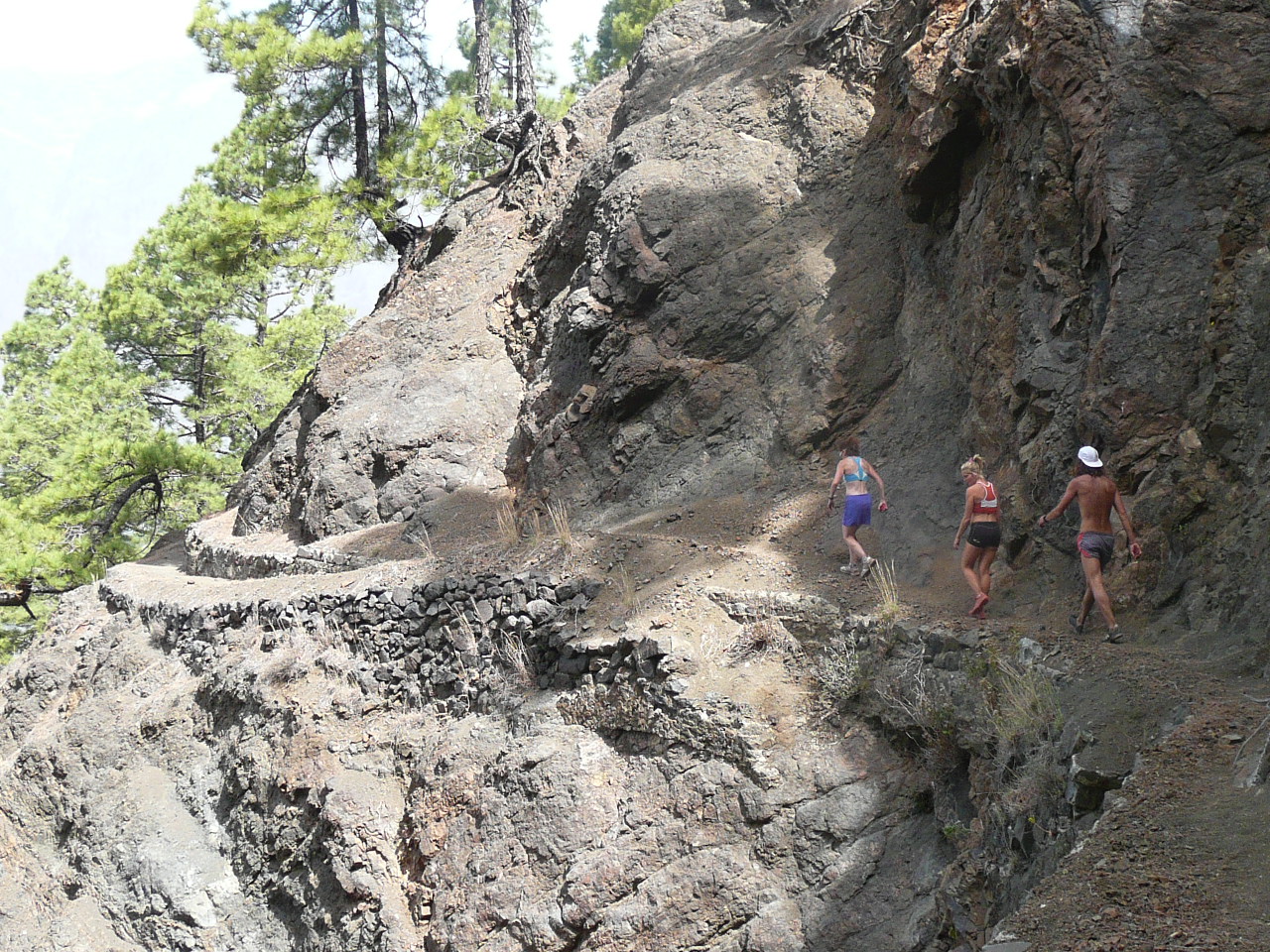
The thing that everyone out here has commented on is what a beautiful island La Palma is, even though most of us hadn't heard of it, just knowing of the more famous nearby tourist islands of Tenerife and Lanzarote. When the sun rises and you get views over black, volcanic lava flows, then the sea far below, it’s hard to not be amazed…even when your body is working so hard to keep climbing.

In summary, the course was a 6,500ft climb to start off with, partially pre-dawn and through villages with a UTMB atmosphere, then a downhill before a steeper climb, some undulation and a final push to over 8,000ft before descending to sea level. Then the last few miles were flat followed by a final, sharp 1,000ft climb and a mile long road sprint to the finish in the blistering heat. From that highest point you could see much of the island (including the finish line over a half marathon away) and I wish I could have spent time enjoying it instead of then hammering downhill and looking just ahead of my feet the whole way.

The International Skyrunning Federation (“ISF”) have moved into the ultra world this year and this race kicks off their season of races with more than a bang. Dakota Jones (6:59) and Anna Frost (8:11) smashed the course records with incredibly impressive runs against stiff competition. Virtually everyone I saw seemed to be in the Salomon kit and I spent the whole day around different Salomon racers – they’ve really thrown their weight behind this.

Given the difficulty of the course I thought top 10 was a tough aim and would still require besting some incredibly strong runners. In the end I got 16th in 8:20, but am very encouraged that the 8,000ft+ descent went well (ideal training for Western States), moving from 30th at the top to my final position a half marathon later.

It was a tough day and the heat was more of a factor than I expected, with dehydration causing me some issues (my own fault for not drinking enough), but the North Americans had a much better showing than at UTMB with the men’s win and 3rd (Nikki Kimball) and 4th (Darcy Africa) in the ladies’ race. In fact, I was the last of the North American men to finish (Geoff Roes dropped after some nasty stomach problems) so the rest were all ahead – Rickey Gates (10th), Joe Grant (11th=), Mike Wolfe (14th). Full coverage of the race and results is here.

If you get the chance to run this and like the idea of a beautiful tropical trip before the summer starts, plus a very hard course, then this is perfect.

The next few days have a 3-day seminar about the future of Skyrunning, plus some pool time. Then off to northern Spain and the Pyrenees for the Zegama Marathon. At the moment none of us plan to go all out as we have varying degrees of minor limps, but I’m sure some of the guys out here will end up going hard. Fantastic trip so far and well worth the long flights – thanks ISF! 

Monday, 7 May 2012

Race Travel

The trail to Everest Base Camp at the only ever running of the multi-day Land of the Yeti Duathlon, 2009


Tomorrow I head off for the Canary Islands for the super-stacked Transvulcania 83k with around 15,000ft of climbing in a double marathon. It starts off a month of travel back to Europe for the Skyrunning Federation conference and two of their races (the other is the Zegama Marathon in the Spanish Pyrenees), plus the Northants Ultra by where I grew up and a quick trip to Chamonix for some training. Bryon Powell from irunfar will be covering both Skyrunning races live and has noted yet another long list of fast runners will be there - see his article here.

Both these mountain races are extremely tough by my standards in terms of the amount of climbing so they're mainly a new and harder challenge for me and a chance to see some new places and faces. One of the things I most love about ultras is that they provide an excuse to see incredible locations around the world and I've tried to use races to see more of the planet, having raced in over 30 countries currently (I have zero chance of ever completing my wish list as I won't live long enough to fit it all in - I'd need a millennium). New cultures and friends really add spice to life, although returning home can sometimes be depressing...although that's not really the case now I'm in Oregon, which kind of feels like a permanent adventure.

Without events that take me to some of the best scenery I can imagine, I'd probably never have seen the middle of the Sahara, small alpine villages or a whole host of other fantastic places. I'm often amazed by the commitment and organizational ability of race directors to create courses in harsh environments and out of the way locations, so I'm very thankful for the great work so many of them do, often purely for love of running and not for profit.

Race travel has been a large part of my life since I started running in 2005 and I can't imagine doing without it (just ask my wife who complains that it'd be nice to have the occasional holiday that didn't include a race). But I also try to take advantage of local races too since travel can be a hassle. Given I'm not from the US, just being here and doing almost any event feels like it's exotic. So this year I've got plenty of trail races close to Bend, OR, as well as fantastic Oregon ultras like the Gorge Waterfalls 50k in March and the Waldo 100k in August. I'm even counting Western States 100 as kind of local since it's at least in the same time zone (that's close for Americans, but not for my British sense of distance).

The one big downside to all this travel, excluding the cost, is adjusting to time zones. My wake up call for Transvulcania will be around 3am local time...or 7pm for my West Coast-adjusted body. After a couple of days of flying then just two days to adjust to this, I'll be a mess. I suspect the Americans may suffer a little from sleep deprivation at the race so don't be surprised if that gives an edge to the European athletes (plus many of them train on more similar terrain, which has a tiny benefit - although we have plenty of tough terrain to play on in the US).

So I hope to have a really enjoyable time meeting some of the most talented people in the sport and seeing places I'd probably never have visited otherwise. Is there any other sport that can offer this to the same degree and allow competitors to get into the least accessible, most beautiful areas? Or if you prefer you can race along a canal which seems to be popular back in the UK, offering such sights as dead homeless people, shopping trolleys (carts), toxic water and being attacked by killer geese.

Monday, 30 April 2012

Why Run A Road Half In Training For A Trail Ultra?

Running hard in a half marathon in 2009


I got back from a trip to Eugene, Oregon this weekend for the half marathon there as part of my Western States build up. So, apart from the fact that I enjoy road racing and that Eugene is Track Town USA (with the US Olympic Trials occurring around WS time), why is that a good training run for a mountainous trail ultra?

One thing that I have found over time is that the more I just run trails, the more I tend to slow down. Yes, the ability to climb and descend gets better, but the pace on easier trails goes down. And WS, like most trail ultras, has a lot of faster running in there as well as some climbs to slow things down a bit.

Apart from downhill, most people are unlikely to hit their half marathon road speed in a trail ultra, but by working on the uncomfortable pace close to your lactate threshold (as a half marathon does), you force your body to adapt and be able to sustain a higher pace when on long runs. Your lactate threshold is basically the exercise intensity where lactic acid starts to accumulate in the blood, when lactate is produced faster than it can be removed. Effectively, this causes a runner to slow down so the higher this boundary can be pushed, the higher his or her sustainable pace becomes.

If you can make 6-minute/miles feel easier (or 7s, 9s, 11s etc) at the high end then it really helps to make cruising speed more efficient too in a really long run.

So why is a half marathon particularly good for this type of training? There are two main reasons I'd suggest for this:

1. Half marathon pace is fast enough to get close to your lactate threshold and push that boundary out so you can run faster, plus it is a long enough race that you have to push hard for a sustained period.

2. It's short enough that it doesn't take too long to recover from for a regular runner, certainly less time than a marathon.

Admittedly, guys with incredibly fast sub 2:20 marathon times haven't generally done as well in 100 milers as their speed would suggest. But it's the combination of the flat out speed and trail fitness that counts. Put a Kenyan Olympian on a mountainous 100-miler without specific training and they'd obviously not be bad, but they wouldn't automatically be the best unless they trained well for and adapted extremely well to the specifics of a mountain ultra (the same applies in the other direction but is more obvious to people and has been more tried and tested).

Speed training can be done on trails and hill work is similar in many ways, but if you like roads then they can really help as part of trail ultra training.

Monday, 23 April 2012

Kit Choices For 100 Milers

Which shoes to choose?


The one rule that every ultrarunner learns to stick to, often after a bad and long day on the trails, is to not try anything new on race day. So Western States is exactly two months away today and I realized I needed to make sure everything I want to use there gets well tested and worn in. It also brings home that I only have 61 days left to get in the best shape possible, which seems like hardly anything.

So it's time to try out all those flavors of Clif gels I haven't tried yet (just in case they work better or worse), to wear in the shiny new shoes that I've been saving for the race and to make sure I have everything I think I'll need (anyone got a spare pair of Kilian legs?). It may seem a long time in advance to do this, but this way it's possible to have complete confidence in all the gear I'll take with me.

Made me think there's probably a few other people (approximately 400) who are starting to realize that WS is just around the corner, especially after a scorching weekend all along the west coast. And all those who have other summer target races - they're all very close now so don't leave things to the last minute.

And the obvious way to prepare for those summer mountain races...to run the Eugene Half Marathon on Sunday. Because when Track Town USA is a short drive away it's a waste not to.

Friday, 13 April 2012

How Many Ultras Can You RACE Per Year?

It's over three months into the year and there have already been several very high quality competitions at races this year in the US, before the main season gets going. The Way Too Cool and Chuckanut 50ks had great fields, Lake Sonoma 50 miler is this weekend with a large contingent of top talent. And the coming months will have so many more races that just get more exciting (for me, anyway) every year as they get more and more competitive.

So this leads me to feeling like I'm missing out when I can't get to all the events I want to be at. I didn't get to any of the races mentioned above, although I have had some fun races in the past month and am not complaining about those. In the past I just entered races virtually every weekend, but the more I race ultras, the less feasible this becomes, especially having moved to 100ks and 100 milers. Mike Wardian seems to be the only person who doesn't get worn down if he does a huge number of marathons and ultras and I always used to run 30+ per year, but over the past year I felt like I was doing too much.

It's a tough decision to have to miss so many events and it's obviously not possible to run everything, even at an easier pace, especially given travel and timetable clashes. But if you're as addicted to racing and running as I am then missing out on some fun races just can't be helped. At least there's the option of volunteering or crewing to still be part of events without having to wear yourself down.

So have fun at Sonoma 50 this weekend, you lucky bastards! But I'll be sweeping the Peterson Ridge Rumble 40 mile course down the road in Sisters, OR. So life could definitely be worse.

Thursday, 5 April 2012

Drug Testing for Ultrarunners (or Any Athlete) - Some Thoughts


In the latest episode of Talk Ultra we interviewed Ellie Greenwood and one of the things we mention is her recent random drugs' test (she also wrote about it here). Instead of clogging up that interview with my own thoughts on this, I thought I'd put them out briefly in my blog. These are likely to be very controversial and I don't in any way advocate cheating of any sort. The rules currently state what substances are banned so that's what we should stick to - I would never dream of going against the rules and never have.

The current anti-doping rules

In general, professional athletes who are subject to World Anti-Doping Agency (WADA) rules need to provide a one hour slot every day where they tell the anti-doping authorities where they can be found. Every single day of their competitive lives! And if you refuse or miss several tests you end up with severe penalties.

Yet for ultrarunners hardly anyone is subject to this very intrusive testing - basically just the podiums of the road ultra World Championships and those who are at the front of a handful of other ultras (as far as I'm aware it doesn't extend much past the top 12 men and women at Two Oceans and Comrades, both of which have significant prize money). I was tested a couple of years ago at Comrades, despite being outside the top 12 and was very nervous for a couple of weeks in case there was some banned substance I'd accidentally eaten in some restaurant food (not because I cheat!).

Isn't that ok if it works?

I personally have a few serious reservations about the system even if it worked perfectly and was guaranteed to make a sport 100% clean. However, I certainly agree that we all want to have a sport without cheating, but I'm not sure this is the way to achieve it, even if the testing did extend to all athletes at the front of all ultra races.

Outside Magazine had a good article from years ago about why negative drugs' tests don't really prove that an athlete is clean and why there are no easy answers for stopping drugs' cheats.

Here are my objections to the system as it is

1. Only parolees are subject to the loss of freedom that the tested athletes are forced to accept - this is a significant impingement on personal freedom. I like not knowing exactly where I may be in a couple of weeks (or months) and would hate to be subject to a dawn raid out of the blue, as most people would agree.

2. The testing currently covers very few ultrarunners so doesn't cover the sport effectively (not that I agree this is the way to stop people cheating anyway). Over time it'll cover more, I'm sure, but even then, see point.

3. Cheats will continue to cheat and find ways around it - does anyone believe it's made professional cycling completely clean? There's still the doubt in people's minds that maybe the only way to get ahead is to find a way around the doping rules rather than to not dope and train the harder than anyone else.

4. This is the most controversial one - the list of banned substances is extensive and is over the top in my opinion. Many of the substances could be ingested by accident within meals (athletes have to be extremely careful they find out ingredients of all the food and medicines they use in case they accidentally take a minor amount of something that could get them banned). I also believe that the term 'performance enhancing' is misleading to some degree. The things that will most enhance your performance in an ultra are perfectly allowable - training and nutrition/hydration during the race. Why are gels not banned, or electrolyte drinks? These enhance performance greatly. The line seems to be arbitrary to me. To take it to an absurd degree, the only true test of our natural abilities is to force us to be sendentary in exactly the same way as each other then race from the couch - anything else is not a truly level playing field.

5. What else is performance enhancing? Over time, surgeries will surely make it possible to improve on the human body. Without opening a related, but totally different can of worms, a couple of South African athletes have caused controversy about whether they have unfair performance enhancing benefits - Oscar Pistorius, the 400m runner, with no legs and 800m champion, Caster Semenya, who was accused of 'cheating' with some kind of hermaphrodite benefit. I'm not delving into those arguments, just showing the complexity of what counts as 'natural' and what's 'unnatural'.


Does that mean I'm advocating every athlete be allowed to do whatever drugs they want?

No. However, athletes will continue to cheat so the drug testing doesn't stop it, just make it harder for them. I have no personal desire to use performance enhancing drugs even if they were allowed, but I look at it as one other training option  that just happens to not be allowed (but still happens). I also can't get in altitude training, underwater treadmills and a whole host of other things that may enhance my performance. I even have several aspects of my training that diminish performance, like drinking alcohol or eating unheathly foods

So if I'm complaining, what's the answer?

I don't have an alternative answer to how to police drugs' cheats because prohibition of items that (some) people will always want to do will always fail. I don't think it's possible, just increasingly expensive in monetary and personal freedom terms. It didn't work with booze and it doesn't work with illegal drugs. It only causes more harm than allowing these practices by criminalizing something that can't be stopped, meaning it can't be regulated and not collecting tax revenues from the industry.

The more items that are on the banned list, the harder it is to patrol. Some will always cheat and be a step ahead of the authorities within professional sports - the enhancing drug comes first then they find a way to screen for it (admittedly having samples of athletes from the past helps to mitigate this, but how do you rationally punish someone for using a substance that hadn't been banned at the time of use?).

Conclusion

Allowing the use of drugs in professional sports wouldn't be a perfect solution by any means but the line of what is and isn't performance enhancing is blurry (going back to my point about gels and electrolyte drinks being allowed). I'm not writing a thesis here and these arguments all deserve much more in-depth discussion than the cursory overview I'm laying out here.

The main point I'm trying to convey is that personal freedoms are not something to be given away cheaply. There's no doubt that prohibition of anything for which there's a strong demand leads to illegal black markets. Whether performance enhancing drugs are banned or not, their use is still a choice some athletes will make and get away with.

I hope you can read this posting in the spirit it's intended - to provoke thought rather than to suggest we should all become drug addicts. But prohibition never works and the current system seems unfair and no testing system could ever give 100% confidence that a sport is completely drug-free.

Sunday, 1 April 2012

Elvis Costume For Sale on eBay (Used)

Photo used with permission. Copyright Glenn Tachiyama.


As mentioned yesterday, my Elvis-themed 50k at the Badger Mountain Challenge 50k in the Tri Cities, WA, was dedicated to charity. As an animal lover I've opted to support the Humane Society of Central Oregon, so you can either donate at http://www.firstgiving.com/fundraiser/comradesTNF/2012?mid=zEcAAA2 if you feel inclined or you can buy the actual costume which I'm auctioning to raise funds.


I've run four Guinness World Records in this costume for the Fastest Marathon Dressed as Elvis and this costume currently holds the record:

- London Marathon 2007 (2:57)
- Rome Marathon 2008 (2:52)
- Seattle Marathon 2009 (2:42)
- Napa Valley Marathon 2012 (2:40)


I've also run two ultras in it, the 2011 Miwok 100k and yesterday's 2012 Badger Mountain Challenge 50k.


If you'd like to own this piece of errr...history...then please bid at eBay. You have until the end of Sunday the 8th of April.

http://cgi.ebay.com/ws/eBayISAPI.dll?ViewItem&item=190662109354#ht_500wt_1156

Saturday, 31 March 2012

Badger Mt 50k and Some More Charitable Fundraising


Top: Photo used with permission. Copyright Glenn Tachiyama.
Bottom: From Miwok 100k last year.


Badger Mt 50k in the Tri Cities, WA, has an exposed course with around 6,000ft of climb. It was only six days after I trashed my legs at the Gorge Waterfalls 50k and I thought it'd be a good idea at the last moment to try to take it easier  and switch my mind-set by making it a charity run for my local Humane Society of Central Oregon and run it as Elvis (donate here if you think my silliness is worth a few dollars).

The Elvis costume, especially the wig, is now is pretty bad shape after four marathons, one 100k and a half marathon. This 50k pretty much finished it off and I was not Elvis at his perfectly coiffeured best. I was kind of like Elvis in his final days but much skinnier.

The plan made sense and I tried to take it a little easier than last weekend, but Justin Yates from Missoula, MT, zoomed up the climbs and I decided to try to keep him in sight. Last year's winner set the CR in 4:51 so I thought something around 4:20 would be around the front. Justin had other ideas and I chased him all day, losing ground on each climb and gaining some back downhill.

It's basically an out and back with three big(ish) climbs each way:


But it wasn't well marked and we both went off course multiple times. The 100 milers who started 24 hours previously must have struggled to navigate, especially in the dark.

I had a fun day and couldn't keep Justin in sight for the final climb but felt much better than last weekend. However, I didn't really take it easy at all and ended up finishing in 3:56. Justin was a few minutes ahead, smashing the CR with 3:53 and both of us were a lot quicker than I expected anyone to be running. These past couple of weeks are starting to show a benefit in my training so summer should be fun. Results will be here when they're posted. Bend had another good day after last week's Gorge Waterfalls 50k as Darla Askew set a new CR in 4:46 (she qualified for WS100 at Waldo last year so will be running there too).

One consolation I had every time I struggled up a climb or got almost blown over (the wig mainly stayed on by itself) in the high gales around the turnaround, was that I was doing something much more fun than the Barkley 100, which started about the same time. Those poor b@stards going through misery and getting their legs torn to shreds by the bracken as they do somewhere between 10,000 and 12,000ft of climb for every 20 mile loop. I feel very smug right now, but good luck to everyone out there. They have a couple of days left at most so could maybe catch this blog while they're stumbling along (I'm talking to you, James Adams, who will undoubtedly be playing with your phone if it has any reception).