
I'd set high goals for myself this year at Rocky Raccoon 100 as I thought there was only one thing to try to do after last year went so well - really go after the clock. Normally this is the opposite of what I do since I firmly believe that your best time in a race is usually from sensible pacing so that you don't slow down much or at all, as I mentioned in a previous post.
But it's a game of odds regarding maximizing your chances at a good run. So to go after the most ambitious target required more of a risk and that's what I decided was worth trying. I had A, B and C goals - 12:32:04 (World Best), 12:44:33 (Course Record) and 13:16:02 (previous Course Record), all of which were ambitious. And I thought that I'd need to go through the end of lap two at 40 miles in 4:50 (last year 4:54) and lap four at 80 miles in 9:50 (last year 9:58) to have a shot...not easy on the trails on a good day.
Race morning started and there were thunder, lightning and possibly the Mayan calendar's predicted end of the world. It was hard to tell with all the rain. Hal Koerner, Karl Meltzer and myself started off at the front in the dark first few miles, with Karl having to stick close since his headlamp was weak and he couldn't see the trail well without our lights.
 |
| The start line. Photo: Drymax Socks |
By the DamNation aid station at 6.2 miles we also had Oswaldo Lopez running with us and it stayed like that for the first lap, with Oswaldo on my shoulder then the other two just behind. Great to meet him more after seeing his great win at Badwater last year first hand. 2:27 for lap one put us on target, but it felt fast, partly due to the mud. Oswaldo and myself had broken away slightly, then I sped up to go through 26.2 miles in 3:10 on my own, three minutes ahead of last year and flying along feeling good.
 |
| Oswaldo Lopez. Photo: From Oswaldo's Badwater-style crew. |
 |
| Hal Koerner charging in the lead on lap three. Photo: Drymax Socks. |
 |
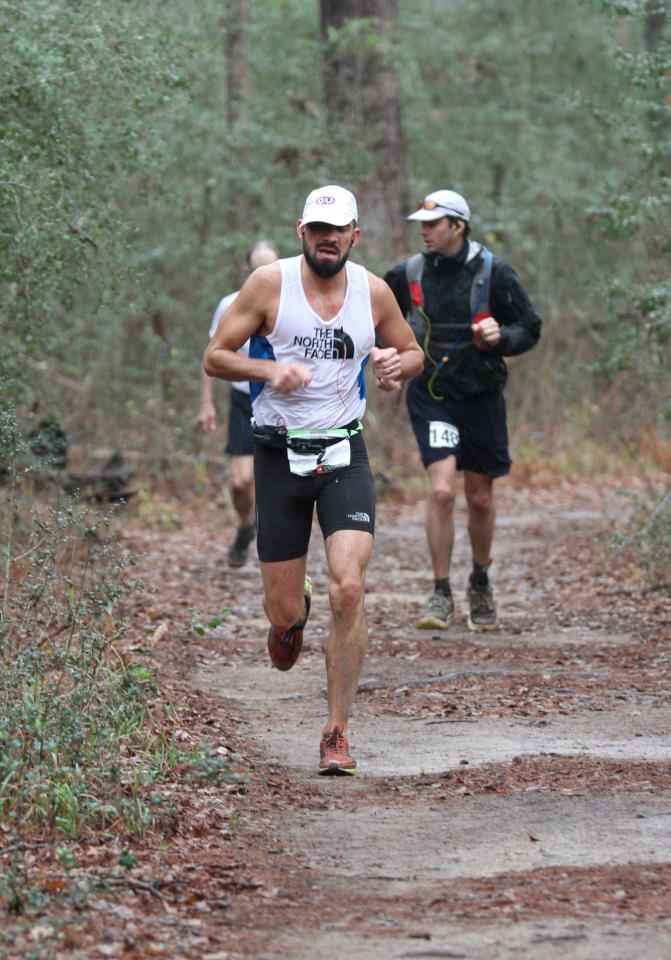
| Me on lap three. Photo: Drymax Socks. |
 |
| Karl Meltzer. Photo: Drymax Socks. |
 |
| Sabrina Moran racing to victory. Photo: Drymax Socks. |
 |
| Liza Howard before she got injured. Photo: Drymax Socks. |
By around 30 miles I caught glimpses of Hal behind and the legs were starting to feel some fatigue. Even with the surface water, the course had been fairly easy to run on in lap one, but by lap two, 680 people had churned it and it was slippery. I could tell I was slowing and Hal caught me just before the end of the loop with us going through 40 miles together in 4:55, just over a minute off last year and too slow for my A goal given I wasn't going fast at that point.
Karl was barely behind us and both he and Hal went past me within the first couple of miles of lap three as I focused on nutrition to help me feel normal again. Even with some walking breaks, I couldn't get back up to the pace I needed and by 50 miles I felt my left hip flexor was very sore. All that sliding over the mud must have strained it more than normal and I soon started limping. By Park Road aid station at 55.6 miles, Hal was 14 minutes ahead and Karl around 5 minutes, but I couldn't run properly and walked parts of the next section to the loop finish.
At 60 miles I had my trusty pacers from last year (who'd done a great job of getting me through aid stations to that point very quickly), Paul and Meredith Terranova. So I ate some food, had a stretch and decided to start out the next loop and hope for an improvement. All (good) time goals had gone from my mind, but if I could only limp then I knew it'd be stupid to do it for over 40 miles and make things much worse. By the 63.1 mile aid station I decided to call it a day, over nine hours into the race. But somehow running through puddles and mud hadn't caused me any feet issues so I know I can trust my Drymax socks - that was something that had concerned me as a potential reason for slowing down.
Hal went on to win in a mightily impressive 13:24, faster than his 13:26 in 2011 and Karl ran 10 minutes quicker than last year, in 14:17. Oswaldo had dropped off a lot but came back for 3rd in 14:30.
Two-time defending champ, Liza Howard, had led for much of the day in the ladies' race but had to drop at mile 80 with a foot and shin injury to leave the way clear for Sabrina Moran to win by a huge margin in 17:06.
Full results and splits here. Congratulations to all the finishers (and starters).
Joe Prusaitis and his team put on a great event with fantastic volunteers and I can't fathom the effort it takes for the runners out there for up to 30 hours of rain and mud (I've still not done more than two thirds of a day on my feet!). I'm happy that I went for the record but learned that maybe less than perfect conditions on the trail should have made me adjust the goal. I think Hal, Karl and Oswaldo would all have run marginally better times if we hadn't started so fast and I'd have probably finished too, but that's hindsight for you. Next year...this is always worth coming back for.


